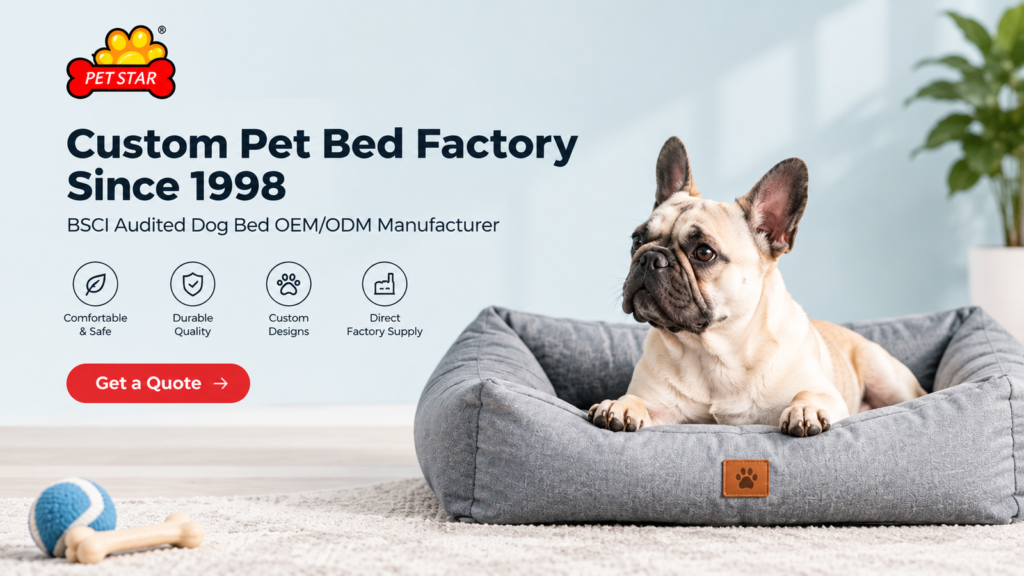

Petstar is a pet bed factory that designs and manufactures dog beds and cat beds for wholesalers, retailers and private label brands. The company operates as a brand of Hangzhou Tianyuan Pet Products Co., Ltd. It has manufactured pet products since 1998. Petstar trades publicly in China under stock code 301335, making it the country’s first listed pet products company.
This pet bed factory runs nine factories worldwide. Locations span China, the United States, Vietnam and Cambodia, with additional subsidiaries in the UK, Germany and Japan. The Cambodia factory alone produces roughly 270,000 pieces per month across 12,000 square meters. The Vietnam facility adds another 150,000 pieces monthly. The US factory turns out about 80,000 pieces per month and counts Chewy and Amazon among its main customers.
Petstar backs its production with real compliance credentials. Its factories hold BSCI, SEDEX, GRS, OEKO-TEX, ISO 9001:2015 and FSC certifications. The company offers full OEM and ODM services, letting buyers customize fabric, size, color, filling, packaging and branding. It stocks more than 9000 fabric options and produces over 200 new items every month.
Petstar serves three distinct buyer types. Specialty retailers like PetSmart, Petco, Petbarn and Fressnapf source private label pet beds through the company. Online resellers including Amazon, Chewy and Zooplus rely on its supply chain too. Supermarket chains such as Walmart and Carrefour round out its customer base.
For buyers sourcing pet bedding at scale, this pet bed factory combines global manufacturing capacity with the certifications larger retail programs require.