
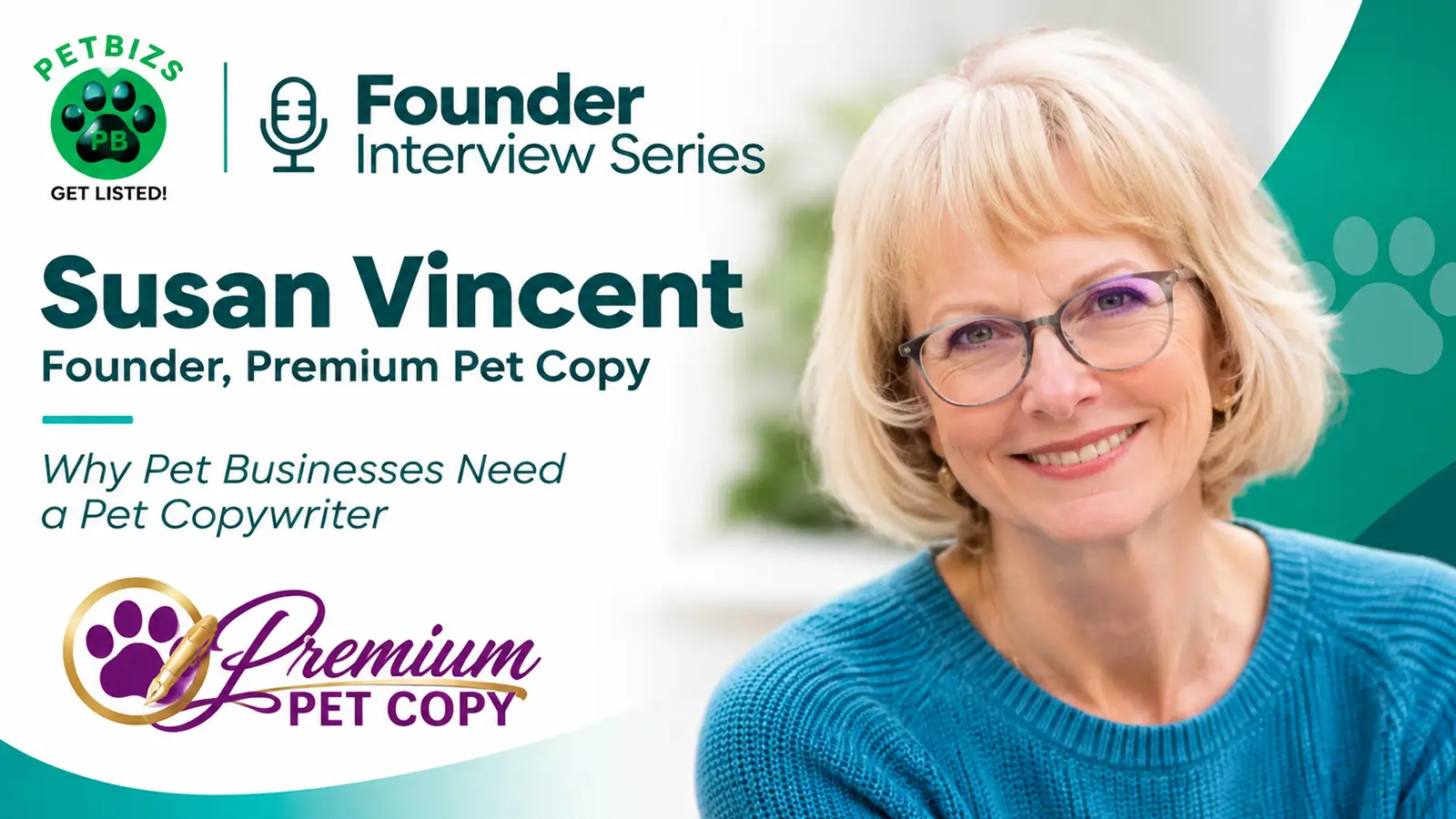
Pet Copywriter Words Work When Pet Parents Feel Understood, Something AI Cannot Fake.
A pet copywriter answers the question pet parents never type into Google. It sounds simple: “Will you treat my pet like family?” Most clinics, groomers, and shops never answer it online. They list services and prices instead, and pet parents keep scrolling.
Susan Vincent has spent more than twenty years turning words into growth. She built Premium Pet Copy to serve independent vet clinics, groomers, and pet retailers.
In this conversation, she explains how words build trust and why AI cannot replace compassion. She also shares how a pet copywriter for vet clinics turns happy clients into loyal ones.
Thank you for joining PETBIZS, Susan. You built Premium Pet Copy to serve independent vet clinics, groomers, and pet retailers, after twenty years writing for industries that had nothing to do with animals. Can you introduce yourself and share what finally pulled you toward pet focused work as your full time focus?
I’m Susan Vincent, founder of Premium Pet Copy. While my work has covered several industries, I’ve actually been writing for the pet industry for over 20 years.
I’ve written stories for The Mosby Foundation since its inception. It’s a local nonprofit with international reach that helps canines in need of veterinary care. The foundation publishes a quarterly paper newsletter with around 800 subscribers. Each year, my feature stories generate an additional $17,500 for the foundation.
That experience gave me a strong connection to animal welfare and pet care. So, moving into the pet wellness industry felt like a natural next step. I wanted to bring my writing experience to independent veterinary clinics, groomers, and pet retailers. That’s what led me to build Premium Pet Copy.
You trained with the American Writers & Artists Institute early in your career. How much of what you learned there still shows up in how you write for pet businesses today?
It shows up every day.
AWAI teaches writers to create copy that converts, a skill every industry needs. I use it to help mission-driven pet wellness businesses find the marketing gaps in their own messaging and their competitors’, that keep them from standing out against big box brands and local rivals. Then I turn those insights into a story that makes pet parents say, “You’re who I’ve been looking for!”
A lot of people assume copywriting is just nice sounding words. How do you explain what a pet copywriter actually does to a vet or groomer who’s never thought about copy that way?
Most business owners, not just the pet industry, devalue the power of professionally written copy. Hours and hours of research are required before a word is ever written. Once that research is complete, it’s time to compile the information that pulls out “the gold nuggets” that make prospects sit up, listen, and take action. Pet parents are looking for professionals who take the time to care and understand. That’s the secret to growing a strong independent business.
You’ve written for industries as different as blacksmithing and custom manufacturing. What made pet care the one you kept coming back to?
I’ve had rescue cats all my life. I like animals more than I like people! Plus, my long involvement with The Mosby Foundation opened my eyes to the cruelty towards animals as well as the deep commitment pet parents have to their fur babies. It was a direction I should have taken years ago.
Your TRUST framework breaks down what a pet copywriter does into five steps, telling a story, removing friction, understanding the customer, showing proof, and turning clients into advocates. Which of those five tends to be the one businesses skip first?
Understanding the prospective client’s needs and asking the right questions so that the prospective client feels seen, heard, and understood. This approach works in generating sales and client retention.
Heidi Lanford credits your newsletter and campaign work with bringing in over eighty thousand dollars in new reservations for the Iris Inn. What did that project actually involve behind the scenes?
Heidi had a raving audience that loved the inn she and her husband owned. That’s half the battle.
Understanding what the client wants and zeroing in on it is the secret sauce of sales. Knowing how to take that trust — because that’s what we’re talking about here — and then positioning the inn as the go-to place to get those experiences was my job. It was all about listening, collaborating, and then drafting copy that met client desires.
Katrina Weiland brought in nine thousand dollars and ten new clients within ninety days of her website launch. How much of that result comes down to hiring a pet copywriter versus just having a website at all?
Katrina had nearly depleted her savings trying to get her business off the ground. She was competing with some heavy-hitting chiropractic offices with insanely low offers.
When she brought me in, I helped her get to the heart of her message, to address the pain points her prospective clients had, then we offered up a “no-hurt” solution that greatly appealed to her audience. I’m happy to say that she’s doing very well now and does not have to worry about her competitors.
You work specifically with vet clinics, pet retailers, groomers, and equine businesses, bringing a pet copywriter’s eye to niches most generalists ignore. What does a strong independent pet business usually get wrong about its own website before you step in?
Most pet wellness businesses focus on the services they offer, what ingredients are in their food, or how caring their staff is. These are important assets, but they are not what pet parents are looking for initially. They want you to answer the question, “How well will you treat my fur baby?” That’s why getting your message crystal clear on your website, demonstrating your value, and showing what makes you stand out from your competitors is essential. Most pet businesses don’t do this, and it’s a costly mistake.
You mention that AI search is already changing how pet parents shop. How is a pet copywriter’s job changing now that AI systems read as many pages as actual people do?
There are two factors at play, SEO and AI. Each works differently to get you found on the Web, but they work together, each with its own set of rules. Copywriters like myself have to know how to use those rules to get companies ranked, found, and cited in the digital marketplace.
Your own cat, Lil, loved shoes the way you do. How often does something that personal end up shaping the tone of the copy you write for a client?
All the time! Owning a pet is not like buying a vehicle. You have many emotions in bonding with an animal you know will only be with you for a relatively short time on this earth. So using that knowledge to connect with your audience is very powerful.
A lot of pet businesses think good service alone should bring clients back. Where does a pet copywriter actually pick up the slack that good service by itself can’t cover?
Every business says they have good service. That’s a given for any industry. Good service is important, but it isn’t going to set you apart from your competitors. Stake a claim in your niche. Know what makes you different from everybody else, then market the hell out of it. Spread it far and wide and never waver from that distinction unless you upgrade it, make it even better than before. Become the obvious choice. When you do that, you don’t have to even think about your competition.
Tyler Randolph mentions keeping seventy to eighty percent of his clients after working with you. What does a retention focused pet copywriter actually do differently from someone writing copy just to get someone in the door once?
Retention is the soul of your business. It’s what brings in recurring income. So you want to make sure you stay in touch with your clients, providing valuable information about caring for their pets, special offers, referral incentives, and newsletters.
Digital newsletters are one of my favorite ways to build a fence around your clients. Providing clients with valuable information about caring for their pet, including a client celebration with the pet parent’s companion animal, talking about something quirky about the pet. Or, how their pet improved with a certain food or the care of a clinic, etc. Watch how fast that newsletter gets shared!
You offer a free marketing and copy review before any real work starts. What does a pet copywriter usually find in that first review that a business owner genuinely didn’t expect?
I’m genuinely curious about their business and ask lots of questions. My goal is to help them see what they can’t see because they’re too close to it. Then, suggest ways to attain the next step in their business growth.
Margins are thin and clients complain about pricing is one of the pain points you hear a lot. How does the right copy actually help a business raise prices without losing clients?
The right copy attracts the ideal client for that pet business. When you attract the people who’ve been looking for what you offer, and you deliver on the marketing promises you made, people are genuinely appreciative. Good marketing copy and follow-through by the pet business are the keys to growing your business without thin margins.
Product pages are one of your core services. What separates a pet copywriter’s product page from the generic descriptions most pet brands default to?
Generic descriptions are just that, generic. But a product description that shows how it solves a problem is something clients can relate to and respond to.
You live on a farm with your husband Robert, his Red Poll cows, and a rescue rabbit named Mamie. How much does that daily closeness to animals shape how you write for clients who care for them professionally?
Living with animals shapes everything I do when writing for clients.
I understand the closeness people feel to their animals, the grief of losing a pet, the joy and love of having an animal BFF. For pet businesses, I relate strongly to their desire to give companion animals their best lives while we have them.
Referral programs come up constantly with your clients. How does a pet copywriter turn a happy client into someone who actually sends new business your way?
You can get happy clients to send referrals by offering them incentives. Depending on the business, it could be a loyalty program that offers bonus points when a referral makes their first purchase.
Other ideas include a free premium upgrade on a product or service, a gift for the pet, and give $20, get $20. The current client and their referred friend each receive $20 credit after the friend’s first qualifying purchase.
You describe your ideal client as wanting to do meaningful, mission driven work and still make a good living. How do you balance those two goals when a client’s budget is tight?
What’s the best way to eat an elephant? One bite at a time. If your budget is limited, or you want to work on just one aspect of your business, that’s fine. I always start where the business is in its growth. I also offer PayPal Credit, if that’s needed. And honestly, for some businesses, it’s better to start with one service, then work into more advanced techniques for growing the business.
Newsletters show up again and again in your services. What makes a newsletter written by a pet copywriter different from the generic monthly update most businesses send?
Newsletters created by the business are much more personal, and they have more personality! When you share valuable information that pet parents are looking for about their pets, people read it! Including what I call a Client Celebration, (I mentioned this in question #12), pet parents want to be a part of that. Who doesn’t want to talk about their dog or cat? The point is to keep the focus on what gets pet parents excited and involved with your business. This builds a fence around your client. Mass mailings can’t do that.
You measure results and tweak the work as you go rather than writing something once and walking away. How does a pet copywriter actually prove the work is paying off over time?
Analytics and tracking. I find out which posts drove appointment inquiries and whether the landing page call-to-action is converting. I uncover whether a reader who came from Google behaves differently from one who found the business on Facebook. With this information, I don’t just write about what seems popular; I write about what’s driving traffic to the site. For example, for a vet clinic, I could say, “Our vaccine posts drove 14 inquiries last quarter. Let’s do three more like that.”
As more pet businesses compete for attention online, how do you see the role of a pet copywriter becoming more important over the next few years, not less?
Pet copywriters will be in more demand.
Right now, business owners feel AI can write their copy for them, but AI doesn’t know what it means to love an animal so much you’re heartbroken when they die. Marketing needs a human touch that conveys compassion, warmth, and understanding. I also analyze what your top competitors are doing and then use that to find the gap in the marketplace, then create a desire in the prospect to learn more. AI can’t do that.
If a vet clinic or grooming salon has never worked with a copywriter before, what should they actually expect from that first conversation with you?
They should expect me to ask a lot of questions about their work. What’s working? What isn’t working? What do you want your business to do for you in five years? Questions such as these help me understand the best way to approach growing your business. Once I understand what you want to improve or grow, then we talk strategy.
You call your approach a category of one, positioning a client as a trusted advisor rather than just another option. How does a pet copywriter actually build that kind of trust on the page?
Most of us are too close to the work we do to see our own value. That’s why I help pet business owners turn their expertise and unique value into a competitive advantage with words that connect and sell to your target audience. Once you know what makes you different and you market that advantage, you become a category of one, or the obvious choice with which to do business.
What’s one belief about marketing you held early in your career that working specifically with pet businesses eventually changed?
My belief has always been that marketing is about the message. That hasn’t changed. Once you get the message right, the sky’s the limit.
As we wrap up, what do you want independent pet business owners to understand about working with a pet copywriter, and the kind of trust you believe every client relationship deserves?
When you ask me to help you grow your business, you’re trusting me with your livelihood. That’s a responsibility I don’t take lightly.
We agree upon what each party is responsible for and the timeline for getting work done. I listen to you and ask many questions about your business. Further, I do the research, discuss it with you, and, upon approval, I begin writing. I’ll send you several headlines and the opening to make sure I’m on track. Then I’ll finish writing the work. We’ll discuss it and make changes as needed. Then it’s handed off to you.
It’s always a collaborative effort! I learn from you, and you learn from me. It’s fun!
Let’s Wrap It!
Thank you, Susan, for showing what a pet copywriter really does. Your answers made one point plain: good service needs a clear message to reach pet parents. You also showed how a niche claim, a steady newsletter, and referrals keep clients close. And you reminded us that compassion is something AI cannot write.
If your pet business needs a pet copywriter who earns trust, start with Susan. Visit Premium Pet Copy to learn more.
Does your brand have a story worth telling? Get listed on PETBIZS and share it with the pet industry.