A $158 billion U.S. pet industry, yet dogs are still stressed, groomers are burning out, and families are lost. Integrative Dog Grooming asks why.
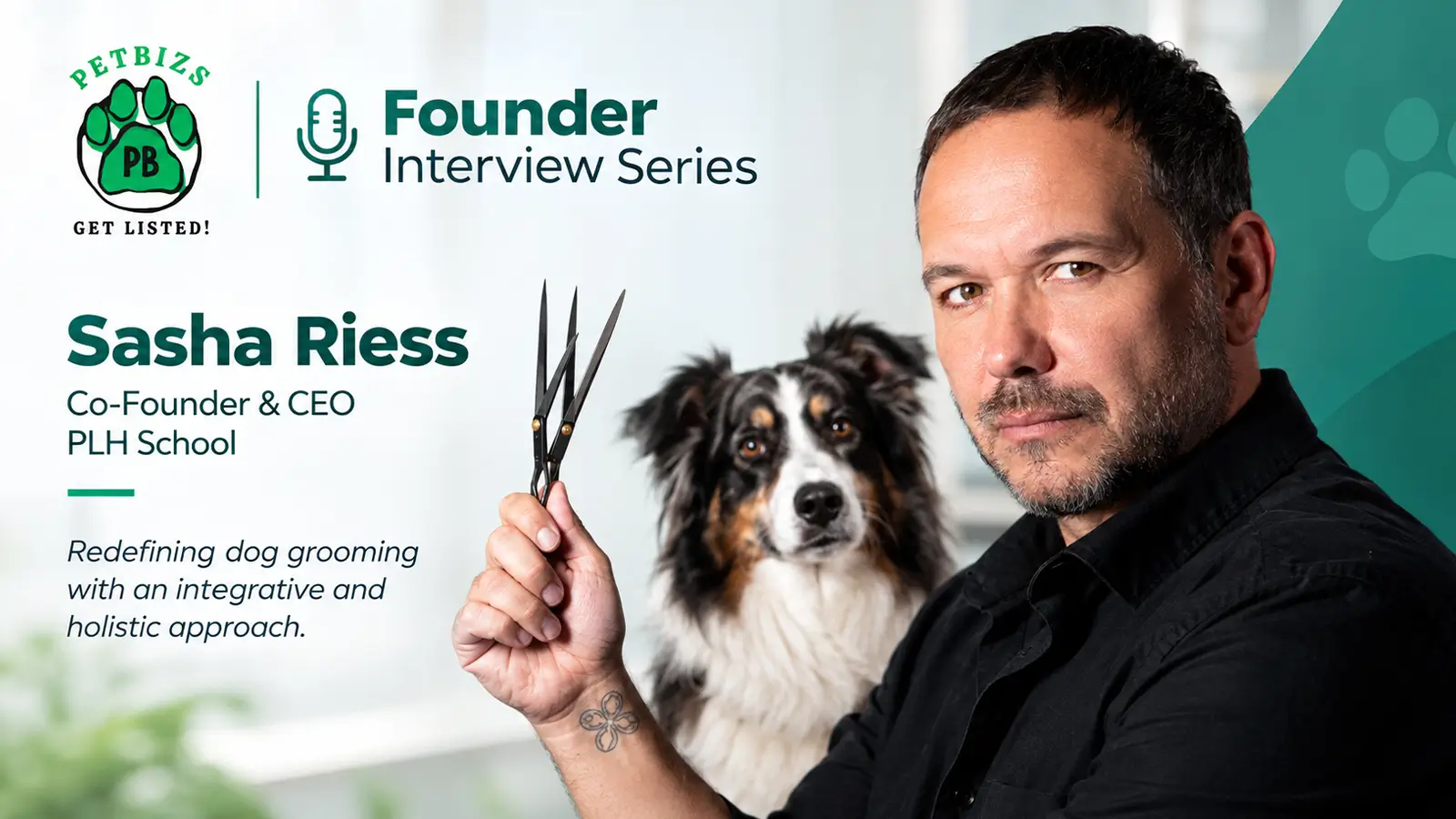
Every profession reaches a point where an old assumption starts to wobble. In dog grooming, that assumption is that the job begins with the first brush stroke and ends when the dog leaves the table. But what if a groomer’s real work starts long before the appointment and continues well after it? Sasha Riess, Co-Founder and CEO of PLH School, has spent years turning that question into a working philosophy.
In this PETBIZS interview, he sits down for a candid conversation about Integrative Dog Grooming: where the idea came from, why it challenges the way many of us were taught, and what it could mean for anyone who has ever held a pair of clippers.
Thank you for joining PETBIZS, Sasha. Your work at PLH School and your vision for building the world’s first Integrative & Holistic Dog Grooming ecosystem is drawing serious attention across the pet care industry. Before we dive in, can you introduce yourself and tell our readers what first pulled you into the world of professional dog grooming?
Thank you for the invitation and for opening a platform for this conversation. I appreciate the opportunity to speak not only about grooming as a profession, but about where pet care is moving, what modern pet parents are asking for, and what responsibility we have as professionals to evolve with that.
My journey with animals began in loneliness. As a child, I was bullied physically and emotionally, and animals became the place where I felt safe. In many ways, they saved my life. But just as strong as that bond was curiosity. From childhood, I kept asking one question: why? I was not interested only in learning how to do something. I wanted to understand what was underneath it, why it worked, why it did not, and what we might be missing entirely. That question shaped my education.
I began veterinary studies and worked in a clinic, but I withdrew after confronting parts of the curriculum that justified animal suffering through economic necessity. I did not want to train my mind to accept that relationship with animals.
From that point forward, I felt a responsibility to find another way and give something back. That exploration took me across the world and into professional show dog handling, but also much deeper into ethology, behavior, evolution, biology, biomechanics, nutrition, and the human-dog relationship. I was fortunate to learn from a small number of extraordinary mentors who challenged the conventional thinking I held at the time and pushed me to keep asking deeper questions.
After retiring from professional handling in 2015, I finally had the space to begin connecting all those pieces.
The U.S. pet industry reached roughly 158 billion dollars in spending in 2025, yet we still see around four and a half million dog bites every year, with hundreds of thousands of people requiring medical care. In 2025 alone, insurers paid approximately 1.86 billion dollars in dog-related injury claims.
In 2025, roughly 2.4 million dogs entered U.S. shelters, and about 209,000 dogs were killed in shelters that year. To me, that adds another uncomfortable layer to the contradiction. We have built a pet industry worth more than 150 billion dollars around our love for animals, yet hundreds of thousands of dogs are still being surrendered, and more than 200,000 are still losing their lives in shelters in a single year. That tells me that loving dogs is not enough. Spending money on dogs is not enough. If our industry continues to grow while families remain confused, then I think we have to ask whether the system we created is actually serving the animal at the center of it.
That contradiction matters. I believe our industry has to be willing to look at its own role in it. Not because people do not love their dogs, but because the structure of pet care often divides the dog into disconnected services, each with its own answers and very often its own products.
And the more confused a pet parent becomes, the more opportunities there are to sell another solution. I am not saying that professionals intend harm. I am saying that the structure rewards fragmentation far more than integration. That is where I believe we have to be honest with ourselves. Families are left trying to assemble their dog from scattered pieces of advice.
That realization became one of the driving forces behind the Pure Love and Harmony Methodology, which gave rise to Integrative and Holistic Dog Grooming as a practice intended to support a harmonious life between humans and dogs sharing close space in the contemporary world.
The goal is to move away from an industry that can profit from fragmentation and toward a profession that helps people understand how all these pieces connect, so the decisions they make are centered on the dog and lead toward truly species-appropriate care.
You built a career across three continents, from show dog handling to teaching at some of the biggest names in the industry, before taking the helm at Texas AllBreed Grooming School. What made you believe this school, with roots dating back to 1984, was the right home for the next chapter of your career?
Before Texas AllBreed Grooming School, we tried to build partnerships around Integrative and Holistic Dog Grooming with other businesses, and those attempts failed. The difficulty was that people wanted immediate measures and simple answers. They wanted to know how a complex idea could be reduced into something easily marketed, and when they could not see that quickly enough, they gave up.
But ideas simply need time. A seed grows through the winter when nothing can be seen above the ground, yet an incredibly complex process is already happening beneath the surface. Then spring comes, and suddenly what looked like nothing begins to show itself.
That is how I see this journey. The work was happening long before the results became visible. Texas AllBreed had the patience and courage to allow that process to unfold.
That is what made it the right home. It was not that everything was already perfectly aligned. It was that there was enough trust, experience, and courage on both sides to build something together. We implemented the Pure Love & Harmony Methodology and together created PLH School. (Pure Love & Harmony School)
Texas AllBreed is moving forward, trough PLH School project, faster than anyone expected, me included, to be honest.
For me, that is the real proof that sometimes the most important decision is simply having the courage to move before the outcome is guaranteed.
Texas AllBreed Grooming School a rich legacy, founded by sisters in law Gail and Joan Derouin and later shaped by Denise Reed. How do you honor that history while introducing something as ambitious as Integrative & Holistic Dog Grooming into the curriculum?
Texas AllBreed Grooming School still operates as Texas AllBreed Grooming School. Pure Love & Harmony did not come in to replace its history or rebuild the school in our own image. What we created is a merge. Texas AllBreed carries the legacy, experience, and foundation built since 1984, while the Pure Love & Harmony Methodology brings the Integrative & Holistic Dog Grooming curriculum, and those two come together within the PLH School structure.
That distinction matters to me. I have no interest in erasing what Gail, Joan, and Denise built. My responsibility is to respect that foundation while helping the education evolve toward species-appropriate care, a deeper understanding of the dog, and the realities of the profession today.
Many readers will encounter the term Integrative & Holistic Dog Grooming for the first time through this interview. How would you define it in your own words, and what separates it from the grooming education most professionals grew up with?
Integrative & Holistic Dog Grooming is really about understanding that grooming does not exist in isolation.
For me, integrative means bringing the disciplines that directly influence the grooming experience into one professional foundation. Behavior matters, and not simply whether a dog is “good” on the table, but what that behavior is actually communicating. Nutrition matters because you cannot separate the condition of the skin and coat from the condition of the body producing them. Coat and skin care matter as part of that system, not simply as preparation for cutting or sculpting hair.
Technical skill is essential, but skill alone has limits. You can be an exceptional stylist, but if the dog cannot cope with the process, or if the coat and skin are unhealthy, your technical ability can only take you so far. This is why we integrate these areas into the fundamental knowledge of the future grooming professional.
Holistic comes from the Greek holos, meaning all, whole, entire, or complete. I think that word has been turned into a lifestyle or wellness label, but its original meaning is much more useful. It is the understanding that the parts of a system cannot be fully understood independently from the whole.
And when we talk about the contemporary dog, that whole cannot stop with the dog. It includes the human family and the environment they live in. Two dogs from the same litter can share the same genetics and still develop very different levels of wellbeing because their routines, nutrition, relationships, daily experiences, and environment are shaped by the beliefs and choices of their owners.
So holistic, in this context, means taking all of that integrative knowledge and applying it to one dog at a time. There is no book that can completely predict that individuality. There is no protocol that fits every dog and every family. Our job is to understand the system in front of us, then adapt our knowledge to that dog, that family, and that reality.
That is the difference for me. We are not only teaching someone how to groom a coat. We are teaching them how to understand the dog whose coat they are grooming.
Your website describes PLH School as building the world’s first Integrative & Holistic Dog Grooming ecosystem. What does an ecosystem actually look like in practice, and which pieces had to come together for you to call it that?
For anyone to learn, explore, and develop skills they did not have before, one thing has to come first: safety.
That is why we built the educational system around the emotional safety of the student. People do not grow well in environments where they are afraid to ask, afraid to fail, or constantly protecting themselves from judgment. We want students to have enough structure, support, and trust to experiment, make mistakes, reflect, and grow.
The same principle applies to the ecosystem itself. It is not one isolated service taken out of context. Chemically evaluating the coat itself is just a laboratory test. Nutrition by itself is incomplete. Behavior education by itself is incomplete. Coat and skin science by itself is incomplete. Products, tools, grooming technique, business education, and continued mentorship are all limited when they stand alone.
We call it an ecosystem because these parts are connected and designed to support one another. The student learns in a safe environment, then learns how behavior, nutrition, physiology, coat and skin, communication, products, professional practice, and continued education influence the whole.
That is what we are building. Not a collection of disconnected services, but one environment where professionals can continue to grow and where every discipline serves a deeper understanding of the dog.
You often speak about grooming moving beyond outdated, human centered practices. What moments in your own career convinced you the industry needed a more species appropriate approach to caring for dogs?
Our industry was largely built around making the human workload easier, and somewhere in that process we lost sight of the dog.
Many practices we consider normal were designed primarily for efficiency and control. For example, we put dogs on elevated tables to protect our backs. We restrain them so they cannot jump or fall. We create systems that help us complete the service safely and predictably. Those needs are real, but we rarely stopped to ask what those same systems feel like to the dog.
An elevated surface can activate a fear of falling. Restraint can increase the feeling of being trapped. Pressure around the neck and body, noise, dryers, unfamiliar handling, and the inability to leave can create a powerful survival response. A dog who freezes is then easily described as “well behaved,” when physiologically that stillness may represent fear rather than relaxation.
There is also a historical reason for this. Professional pet grooming expanded rapidly as dogs moved more deeply into the home and increasingly became companion animals. The American grooming trade became much more organized during the 1960s and 1970s, with vocational schools, associations, trade shows, and a growing professional identity. What changed much faster than our methods was the dog’s role in human life. We were no longer simply maintaining working animals. We were grooming animals living in our homes, sleeping in our beds, and participating emotionally in family life.
Today we also understand much more about stress physiology. Cortisol is part of a necessary survival system, but repeated or prolonged stress affects metabolism, immune regulation, and other physiological systems. Research in dogs also links stress with changes in the gut microbiome and broader health consequences.
There is even veterinary forensic evidence showing that grooming environments can become medically serious. In one necropsy study of 94 dogs that died during grooming or related pet-service procedures, 31 percent died from blunt-force trauma, while the remaining cases showed signs of stress associated with pulmonary edema and hemorrhage. That does not mean grooming itself routinely causes death, but it should stop us from pretending that stress during professional care is insignificant.
What I keep questioning is where repeated grooming experiences fit into that larger health picture. Current veterinary estimates suggest roughly one in four dogs will develop cancer during their lifetime, with the risk rising significantly in older dogs. I am not saying grooming stress causes cancer. That would be irresponsible. But when we already know chronic stress can influence immune regulation, metabolism, inflammation, and the gut microbiome, I think we have to ask harder questions about an experience many dogs repeat throughout their entire lives. If a dog enters survival mode every four, six, or eight weeks for years, I do not think we should automatically treat that as biologically irrelevant just because grooming is considered routine.
Communication, nutrition, and coat care sit at the center of your teaching philosophy. How do these three elements work together to form your model of Integrative & Holistic Dog Grooming?
They are not three separate pillars. They are one interconnected system.
We already know that stress and behavior influence the gut. If a dog is living under constant stress, even excellent food may not be digested, absorbed, stored, or used as efficiently as it should be. That means nutrition cannot be understood only by looking at what is in the bowl. We have to look at whether the body is actually in a state where it can use those nutrients properly.
Then we come to the skin and coat. The skin is the largest organ of the body, and the coat is produced through that system. Its condition reflects far more than grooming technique alone. Stress, nutrition, metabolism, environment, and overall health all influence what we eventually see and feel in the coat.
So communication helps us understand the dog’s emotional and behavioral state. Nutrition supports the internal systems. Skin and coat show us part of the outcome.
For me, this is the kind of interconnected knowledge contemporary pet care professionals, especially groomers, need to understand and apply. Modern pet parents are no longer looking only for someone who can make their dog look good. They are looking for professionals who understand how the pieces fit together.
You have described the grooming industry as facing a genuine workforce crisis. In your view, what is pushing experienced groomers out of the profession, and what is keeping new talent from walking through the door?
Experienced groomers are leaving because too much of the profession has been built around physical exhaustion, emotional overload, unrealistic scheduling, and the idea that burnout is simply part of the job. Many have spent years working in pain, managing difficult dogs without enough behavioral education, absorbing pressure from clients, and trying to survive on volume.
At the same time, new people look at the profession and often see hard physical labor, limited career structure, and little protection from burnout, and education that may teach technique without showing them a bigger future.
That is the workforce crisis. We do not just have a shortage of groomers. We have a profession that has not always given talented people enough reason to stay.
If we want the next generation, we have to offer more than a job cutting hair. We have to offer education, professional identity, deeper knowledge, career development, healthier working models, and a sense that this profession is going somewhere.
And I think we are standing at a crossroads. The grooming industry and the market it serves are not always moving in the same direction, and today that separation is more visible than ever. The pet market has become enormous, yet many of the people physically delivering professional animal care are still earning wages that do not meet a basic living-wage standard. Federal data places median pay for animal caretakers at roughly $17 an hour, while across the U.S., a single adult with no children generally needs around $22 to $24 an hour just to meet basic living costs, depending on location. Something is structurally wrong when consumer spending and expectations keep rising, but the professional standing in front of the dog is exhausted, physically hurting, and struggling to build a sustainable life. That disconnect is part of the workforce crisis. The market is telling us there is tremendous value here. Our profession now has to learn how to create, communicate, and capture that value.
How does Integrative & Holistic Dog Grooming address that workforce crisis directly, rather than simply adding another certification for groomers to collect?
Pet parents are already looking for these solutions, and they are already spending money on them. They are paying trainers for behavior problems, nutrition professionals for diet guidance, veterinarians for increasingly expensive medical care, and groomers for coat care. The problem is that these services are often separated, even though the dog is one connected system.
Integrative & Holistic Dog Grooming gives groomers the framework to connect those pieces without replacing veterinary care. Groomers already have one of the most difficult skill sets in pet care: handling dogs safely while working with sharp tools and managing the coat. What is missing is structured education in behavior, nutrition, physiology, and species-appropriate care.
That creates a real opportunity. Instead of relying only on volume, groomers can offer broader preventive support to the clients they already have. Better-informed families, better-supported dogs, stronger businesses, and, I believe, fewer dogs surrendered because owners finally have practical help with the everyday problems they are struggling to solve.
You built the Phi Excellence Program as part of the PLH School offering. What role does it play in shaping groomers who think and work through Integrative & Holistic Dog Grooming principles rather than routine technique alone?
Phi Excellence is really about learning how to take complex knowledge, bring it into one holistic system, and then apply it precisely to one dog at a time.
We are often taught that specialization is the highest form of expertise, but specialization can also make us lose sight of the whole. The whole only exists through the interaction of its parts. No single part has greater value than the others, and the whole cannot function without them.
Phi gives students a mathematical framework for seeing proportion, balance, and relationship. It is rooted in the golden section, approximately 0.618, and in the same search for harmony in proportion that fascinated thinkers and artists such as Leonardo da Vinci. He understood that beauty is not random. It is structured, measurable, and connected to proportion.
That is what we teach the eye to see. Not simply how to copy a style, but how to recognize balance and create it on an individual dog.
And the same principle carries far beyond coat sculpting. It applies to communication, handling, behavior, even to the way we think about putting a balanced meal into the dog’s bowl. Every element is one part of the system, but at the center of that system is always the dog and the humans who shape the environment, relationships, and daily choices around them.
Phi Excellence teaches students to reduce complexity into something they can observe, measure, understand, and then adapt with precision to the individuality standing in front of them.
PLH School has graduated more than 33,000 students and reports a job placement rate above 90 percent. What do employers tell you sets your graduates apart once they enter the workforce?
What we are really trying to develop is not only employability, but an entrepreneurial mind.
Our students graduate with the technical skills to work in a traditional salon, including high-pressure, high-volume environments. In many cases, they are actually overqualified for those settings because they also understand behavior, stress, nutrition, skin and coat, communication, and the broader context around the dog.
The challenge is not that they cannot succeed there. They can. The challenge is what those environments can do to them over time. When speed, volume, and pressure become the dominant model, burnout becomes a very real risk.
That is why we encourage students from the beginning to think beyond simply finding a job. We provide a safe space where they can explore entrepreneurship, build clientele, develop confidence, and in some cases continue working independently within the school environment for six months to a year before launching their own business.
Some open salons and some start house-call or home-based grooming. Yet, some others build consulting, education, or pet-parent support businesses. The model can take different forms because every student is different.
And I have seen something else many times. Students who choose the traditional high-volume path sometimes come back months or years later and tell me, “I wish I had listened. I wish I had used more of what I learned.” I never see that as failure. It is simply another crossroads. The knowledge is still there, the skills are still there, and it is never too late to build differently.
Your content has reached more than 14 million views on TikTok alone. How has building a public voice around Integrative & Holistic Dog Grooming changed the way everyday pet owners understand what happens during a grooming appointment?
My own social media reach is in the tens of millions, but the real reach goes far beyond my platforms. We give our students content banks they can adapt, private label, recycle, and express through their own voice. That means the message keeps moving through their audiences, their clients, and their communities.
What that has shown me is that the market is already there. Pet parents are responding to conversations that connect behavior, nutrition, coat and skin care, stress, and species-appropriate care because these are the questions they are already asking.
The movement around Integrative & Holistic Dog Grooming is proving something important: demand is not the problem. The opportunity already exists.
The real question is whether the grooming industry is willing to move closer to what the market is asking for and capture money pet parents are already spending elsewhere on fragmented solutions.
You bring a patented line of shampoo and conditioner, along with your own grooming tools, directly into the classroom. How do these products reflect the values behind Integrative & Holistic Dog Grooming?
The products are not there to sell a brand. They are there because tools and formulations should support the same philosophy we teach.
If we say we care about the dog as a complete system, then what touches the skin, how we handle the coat, how much friction, heat, pressure, residue, and unnecessary manipulation we create all matter. Products and tools influence the experience just as much as technique does.
So we developed them to support skin and coat health, efficiency, gentler handling, and better outcomes with less unnecessary stress on the dog and the groomer.
For me, that is the point. Integrative & Holistic Dog Grooming cannot be only theory. The philosophy has to show up in the hands, the tools, the products, and the decisions we make during the actual appointment.
Dogs experience a grooming session through sight, sound, smell, touch, and emotion, not just through the physical process itself. How do you train students to read those signals and respond with genuine care instead of habit?
We teach students that comprehensive knowledge is only valuable if they can apply it to one particular dog, in one particular situation, within one particular context. That is where the art begins.
The school gives them a safe environment to practice that. Very often, the first thing they learn is not how to control the dog, but how to regulate themselves. They move from reacting automatically to what is happening around them toward responding with awareness.
That response happens in a very small space of observation. Nothing has to happen immediately. The student notices what is happening in their own body, gives the experience a moment, and then chooses what to do next.
As they become more aware of that process in themselves, they become better at offering the same space to the dog. Instead of instantly correcting, restraining, or pushing forward, they observe. The dog begins to observe them in return.
That is where something important changes. Both sides move away from instinctive reaction and toward response. For me, that is the beginning of genuine communication, and it is one of the most important things we can teach.
Freezing, shutting down, or going completely still are signs many groomers mistake for calm behavior. How central is teaching students to recognize these signs within the Integrative & Holistic Dog Grooming curriculum you have built?
It is absolutely central, because if we misread a freeze response as calmness, then everything that follows is built on a false interpretation.
A dog can be completely still and still be physiologically overwhelmed. That is why we teach students to look beyond movement and obedience and understand the difference between participation and shutdown. The absence of resistance does not automatically mean the presence of safety.
Students learn to observe breathing, muscle tension, eye movement, posture, facial expression, recovery time, and the context in which the stillness appears. They also learn to examine their own behavior, because sometimes the dog is not becoming calmer. The dog is simply giving up trying to change the situation.
That distinction is critical. If we want species-appropriate care, we cannot reward ourselves for creating a motionless dog. We have to ask whether the dog still has enough emotional and physiological space to observe, process, and respond.
You have said you are not looking to add more groomers to the world, but to develop people who want to change lives, both human and canine. How do you spot that mindset in a prospective student before the program even begins?
Our school is open both to complete beginners and to experienced groomers looking for continued education. We recognize previous experience and skills, then build the missing layers around them so the student leaves with a more comprehensive and structured understanding of Integrative & Holistic Dog Grooming.
From the beginning, we make it clear that this is not simply a place to learn how to cut a dog’s coat. That message alone helps attract the right people.
What I look for is curiosity, humility, character, and a willingness to question what already exists in their belief system. We have a rigorous enrollment process with two layers of interviews because we do not automatically accept every applicant.
Everyone is welcome to apply, and we value what people bring from their previous professional and personal lives. But we are also building a generation of professionals who can help pet parents navigate confusion, uncertainty, behavior, nutrition, and species-appropriate care.
One professional can influence hundreds, even thousands, of families over a career. That is a serious responsibility. So sometimes we offer enrollment, sometimes we recommend waiting, and sometimes we suggest another path. The right skills matter, but the mindset and character that allow real transformation matter just as much.
The 14 week Diploma Program moves fast by design. Can you walk us through how a student travels from their first day in the classroom to becoming a confident practitioner of Integrative & Holistic Dog Grooming?
The program is deliberately built in three parts: fundamental theory, model-dog practice, and live-dog experience with real clients.
The first question we ask is very simple: Who is a dog?
Before we teach students what to do with a dog, we want them to understand the species in front of them. We begin with fundamental ethology, the environment in which the dog experiences the world, sensory processing, physiology, and how those experiences can become responses or reactions that we later call behavior. From there, we move into species-appropriate nutrition, and only after those foundations are in place do we move deeply into skin and coat care.
That first part gives students the why.
The second part is model-dog practice. This is where they develop the how. They build hand skills, tool control, sequencing, proportion, and visual judgment without placing the burden of their early learning on a live animal. Through Phi Excellence, they learn mathematical proportion and the golden section. Through biomechanics and harmony in canine structure, they learn to see why a form looks balanced rather than simply copying a haircut.
Then we bring the two together.
The third part is the live dog. Now the question becomes: What does this particular dog need from everything I have learned about why and how?
Students work with live dogs and real clients, and client feedback becomes part of their development. We are preparing them for real professional life, not a protected classroom illusion.
I do not believe dogs should become guinea pigs for students who have not yet developed the knowledge or motor skills to work responsibly. A model dog can stand patiently while a student repeats a movement fifty times. A live dog should not have to spend five hours on a table because someone is still learning basic tool control.
That same structure is why our online students can also achieve strong practical results. They are not simply watching grooming videos. They are first building understanding, judgment, visual perception, and physical confidence, and then applying those skills to appropriate live dogs in their own environment.
So the progression is very intentional: first why, then how, then what for this individual dog. That is how confidence becomes competence instead of simply repetition.
Vedran Popovic and Denise Reed both hold significant roles at PLH School, from student counseling to curriculum development. How does your leadership team stay aligned to protect the school’s culture and standards?
Alignment comes from being very clear about what cannot be compromised.
We can disagree on methods, timing, priorities, and execution, but we cannot disagree on the core standard: the student must feel safe and respected to grow, the dog must be treated with compassion and genuine species-appropriate care, and the education has to remain structured, rigorous, and useful in real life.
Vedran, Denise, and I bring different strengths, and that is exactly what makes the leadership stronger. We do not need to think the same way. We need to protect the same values.
Culture is not maintained by slogans. It is maintained in everyday decisions, in what we allow, what we correct, what we teach, and what we refuse to compromise.
You have taught and published across multiple countries and continents over the years. How has that global exposure shaped the version of Integrative & Holistic Dog Grooming you now teach in Arlington?
Global exposure taught me very quickly that there is no single correct way to care for dogs simply because one country, one school, or one industry says so.
Every culture has its strengths, its blind spots, its traditions, and its assumptions. Working across different countries forced me to compare systems, question habits, and separate what is truly useful from what is simply familiar.
That shaped the way we teach in Arlington. We do not teach students to copy one national model. We teach them to understand principles, observe the individual dog, understand the family and environment around that dog, and then apply knowledge with judgment.
For me, global experience did not make the methodology more complicated. It made it more honest. It taught me that good care has to be adaptable, culturally aware, evidence-informed, and still centered on the individual dog in front of us.
Some students arrive with no grooming background at all, while others already run their own businesses. How do you adapt your teaching of Integrative & Holistic Dog Grooming to serve both groups equally well?
We do not try to make every student the same. We give every student the same framework and let them build it through their own experience.
Every lesson is supported by reflection, workbook work, peer discussion, and in many cases testing and audio learning. One of the questions we return to constantly is: How does this knowledge apply to you, and how will it shape your future professional self?
We do not answer that question for the student. That matters.
A beginner may apply the same lesson very differently from someone who has owned a salon for ten years, and that is exactly what we want. Every student arrives with assets from their professional and personal life. We treat those experiences as material to build on, not something to erase.
The structure gives them comprehensive knowledge. Reflection gives that knowledge personal meaning. That is how one educational framework becomes useful to very different people without flattening their individuality.
PLH School stands behind a tuition refund for students who complete the program and do not feel transformed by it. What gives you the confidence to make a promise like that?
Because if someone goes through the full program honestly, completes the work, reflects, practices, participates, and still walks away feeling that nothing meaningful changed in the way they understand dogs, themselves, or their professional future, then I believe we failed them.
The promise is not based on guaranteeing that every student will become the same kind of professional. They will not. Transformation is individual. What we can stand behind is the depth of the process.
Students are constantly asked to connect knowledge back to themselves, question assumptions, develop practical skills, and apply what they learn in real situations. They are not passive consumers of information.
That is why I am comfortable standing behind it. The program asks a lot from the student, and in return we should be willing to stand behind the value of what we ask them to go through.
Where do you see Integrative & Holistic Dog Grooming heading over the next five years, both inside PLH School and across the wider grooming industry?
I think the next five years will force the industry to choose whether it wants to remain primarily a coat-service industry or grow into a broader professional care model.
The market is already moving. Pet parents are asking more questions about behavior, nutrition, stress, skin and coat health, prevention, and quality of life. They are already spending money trying to solve those problems, often through separate providers who do not communicate with each other.
I see Integrative & Holistic Dog Grooming becoming the framework that connects those pieces.
Inside PLH School, that means deeper education, stronger professional pathways, more continuing education, and more opportunities for groomers to build businesses beyond volume-based grooming alone.
Across the industry, I expect the strongest professionals to become much more than stylists. They will become trusted care partners who understand the dog in context and help families make better everyday decisions.
If another school or salon wanted to bring elements of Integrative & Holistic Dog Grooming into their own programs, what would you tell them is the hardest part to get right?
The hardest part is not adding more subjects. It is learning how to connect them without turning the program into a pile of disconnected information.
You can add behavior, nutrition, coat science, stress, and communication as separate modules and still completely miss the point. Integration means understanding how one influences the other and then applying that knowledge to one dog, one family, and one real situation at a time.
The second difficult part is culture. If the environment still rewards speed over observation, compliance over communication, and production over care, the new knowledge will eventually be swallowed by the old system.
So my advice would be simple: do not start by adding more content. Start by changing the framework through which the professional sees the dog. Once that changes, the rest of the education begins to organize itself around the right center.
Looking back at everything PLH School has built since 1984, and everything you have added since taking over in 2024, what does success look like to you personally in this next chapter?
Success, for me, is not measured first by how large the school becomes. It is measured by whether we help shape a profession that is more useful to dogs, more sustainable for professionals, and more relevant to the needs of modern pet families.
I want to see students leave with real knowledge, real confidence, and the ability to build a life around this work without destroying themselves in the process. I want pet parents to become less confused because they finally have professionals who can help them connect behavior, nutrition, coat care, environment, and everyday decisions.
In the years to come, success looks like seeing this philosophy move far beyond one school. I want to see a large network of professionals, businesses, education, research, products, and services working from the same deeper understanding of the dog. I want Integrative & Holistic Dog Grooming to become part of the professional standard, not something seen as alternative or unusual.
The mission will need infrastructure, resources, and scale to reach that point. If that means building a multibillion-dollar company, then that is part of the responsibility, not the purpose. The purpose is what those resources make possible: reaching more professionals, supporting more families, funding better education and research, creating better solutions, and helping more dogs.
Success, ultimately, is when this no longer depends on me, one school, or one company. It is when the idea becomes strong enough to live through thousands of professionals and millions of families, and species-appropriate care becomes the normal expectation rather than the exception
As we close, what do you want current and future groomers to understand about the future you are building, both for the profession and for the dogs and families it serves?
I want current and future groomers to understand that the future of this profession is much bigger than coat care alone.
Groomers are in a unique position to become 360-degree pet care professionals because they already work at the point where the dog, the family, behavior, skin and coat, handling, and everyday care all meet. And even someone who is not yet a groomer, but is interested in becoming one, is choosing to develop one of the most complex skill sets in pet care. Grooming requires physical coordination, tool control, handling, timing, coat and skin knowledge, movement awareness, and the ability to work safely with a live animal while building trust with the family.
That matters because if someone is a dog trainer, developing advanced grooming skills is difficult. If someone is a nutrition professional, developing grooming skills is difficult. But once grooming skills are in place, adding deeper knowledge of behavior, nutrition, physiology, communication, and species-appropriate care becomes a much more natural evolution.
That is the future we are building.
Not grooming sitting separately beside behavior, nutrition, and other areas of care, but those disciplines connecting through Integrative & Holistic Dog Grooming into one practical framework.
What I want groomers to recognize is the position they already occupy. They are often the professional who sees the dog most regularly, touches the entire body, notices changes early, hears the family’s concerns, and develops a relationship with both over years. That creates an extraordinary opportunity to become the connecting point in contemporary pet care.
The future is not asking groomers to abandon what they already do well. It is asking them to realize how valuable that foundation actually is, build on it, and step into a much larger professional role.
Whether you agree with every word or find yourself arguing with the page, this conversation leaves you with something worth carrying into your next appointment, your next class, or your next business decision: a better question. Integrative Dog Grooming is still a young idea, and the profession is still deciding what to do with it.
At PETBIZS, we’ll keep following the founders who are willing to ask what comes next, and we’d love to hear where you land. Share this interview with a groomer, a salon owner, or a pet parent who cares about the answer.