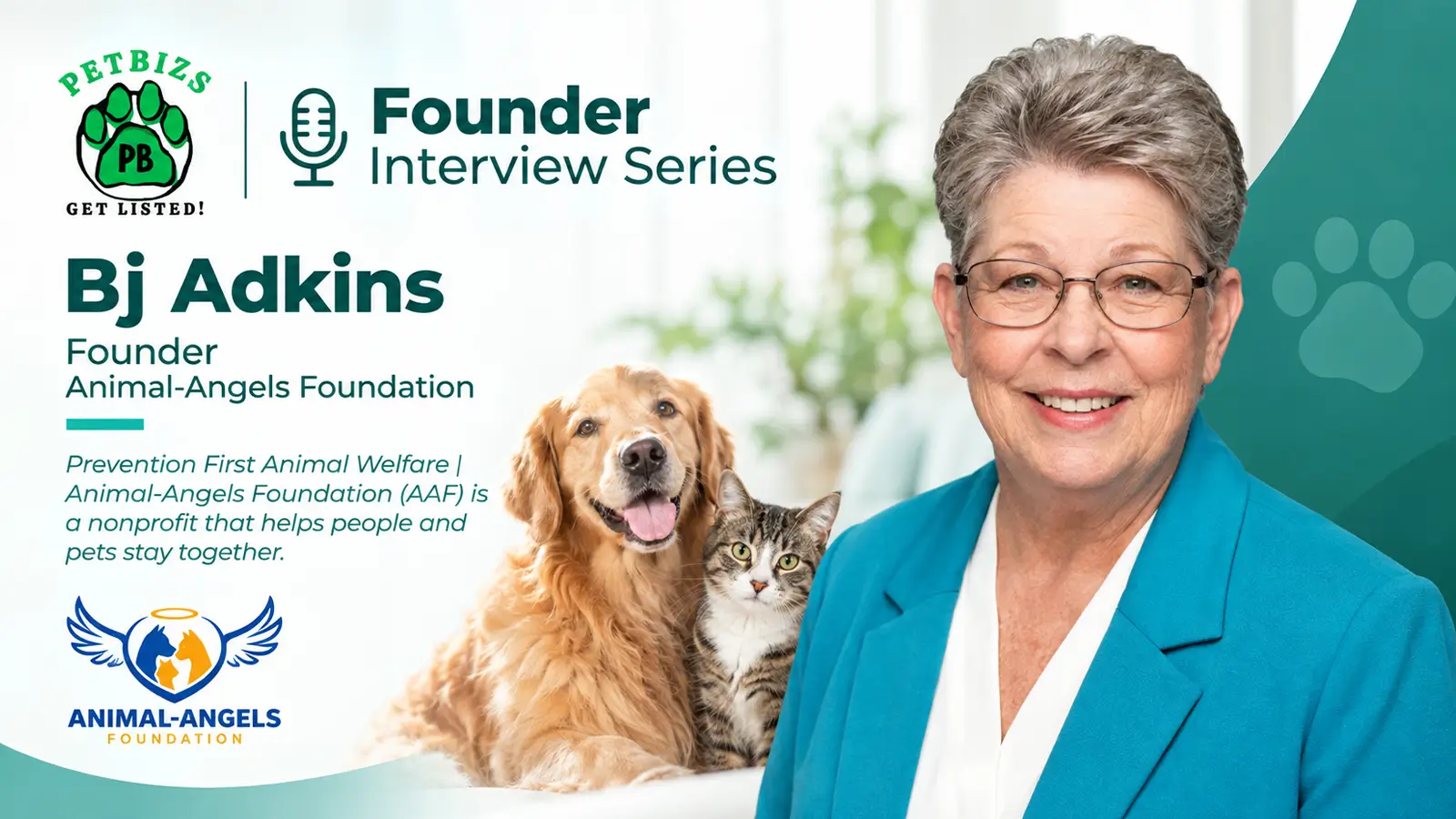
Prevention-first animal welfare wins when the shelter door never opens. Bj Adkins built her nonprofit around that idea, and this PETBIZS conversation shows how it works.
Some people wait for the system to change. Others build a new one. Bj Adkins belongs to the second group.
Meet the founder of Animal-Angels Foundation, a nonprofit in Central Alabama that helps people and pets stay together. Her work rests on one bold idea: prevention-first animal welfare. She believes the best outcome for a struggling family is never a shelter intake. It is a helping hand that arrives in time.
That belief sounds simple. Living it takes grit, planning, and a rare willingness to challenge how the whole field measures success. Bj turns that challenge into daily action. Her answers are direct, practical, and highly useful.
Today, she joins the PETBIZS Founder Interview Series to share her story. You will hear how she sees the problem, builds the solution, and refuses to settle for the old way.
If you care about pets, families, or smarter nonprofit work, keep reading. This conversation will change how you think about rescue, and it may change what you do next.
Thank you for joining us, Bj, and for the work you do for pets and families. Let’s begin at the start of your story. What first pushed you toward this model instead of the traditional rescue or shelter approach?
Watching the same thing happen over and over.
A family calls a shelter to surrender a pet they clearly love. But, by the time they call, every option already ends. The vet bill went unpaid three months ago, and the landlord said “NO” six weeks ago. With this, the food ran out two weeks ago. Nobody was there for any of that. And then the system shows up at the very end and calls it an intake.
The whole apparatus works to catch the animal at the end of the story instead of changing the story. Rescue and sheltering are necessary work, and the people doing it are not the problem. However, the problem is that it is the only layer anyone funds. I did not want to build a better version of the last stop. In fact, I wanted to build the missing part, which is everything that happens before the surrender call.
What were you doing before Animal-Angels Foundation, and what drew you specifically to animal welfare over any other cause?
Before Animal-Angels Foundation, I was retired, and I was fostering for the Greater Birmingham Humane Society. I’ve always wanted to start a nonprofit to help animals. I was fostering three puppies from a horrible breeding situation in Tennessee, which spurred me doing research on what kind of nonprofit I wanted to start.
As a veteran, how has your service background shaped the discipline behind this work?
The military teaches you to build systems that work when the person who designed them is not in the room. That is most of what I do.
At AAF, we write down everything, version it, and put into a process. This is not because I enjoy documentation. It is because a program that only exists in my head is not infrastructure; it is a hobby. The other piece is that the service teaches you to plan for the failure case first.
In animal welfare, there is a lot of optimism and not much contingency planning. I ask
- What happens when the funding runs short
- Or when the partner leaves
- And when the vet cancels, and I build for that version.
And I am comfortable being told no repeatedly and coming back, which turns out to be most of the job.
Where did the name “Animal-Angels Foundation” come from, and what does it represent to you?
To be honest, it was hard coming up with a name because there are so many. I wanted something that said that we were animal-related and a foundation because we’re not a rescue.
You’ve said AAF isn’t a rescue; it’s prevention infrastructure. What’s the most common misconception people have, and how do you correct it?
People hear animal welfare nonprofit, and they picture kennels. They ask how many animals we have. The honest answer is that our best week is one where we did not take in a single animal, because every family we reached stayed together.
Moreover, that is genuinely hard to explain, because our success looks like nothing happening. The way I correct it is with the money. It costs about forty-four dollars to prevent one future intake through spay/neuter. Once an animal enters a shelter, the avoidable handling and medical cost alone runs $250 to $450. And the shelter’s full loaded cost per intake models out to around $900.
Remember, those are modeled figures, not a bank statement, and I say so. But the shape holds at every dollar amount. Prevention is cheaper, and nobody funds it.
What does a typical week look like for you as the sole operator building this prevention-first animal welfare model from the ground up?
A typical week for me is pretty busy. I’ve got:
- The shift to prevention articles to write
- Social media posts
- Donations to work on getting
- And grant funding to apply for
So a typical week for me is Monday through Sunday, sometimes 10 to 14 hours a day.
What was the moment that convinced you prevention-first animal welfare needed to be written down as a framework in The Shift to Prevention, rather than just practiced?
As I started sharing Prevention-First animal welfare, I had a lot of questions from other animal welfare professionals. And they were not only questions but a lot of input into what they were doing. I decided to write down it so that it could be shared with other animal welfare professionals.
Beyond the statistics, what patterns did you personally notice in families surrendering pets that shaped how you designed your prevention-first animal welfare programs?
Three, mostly.
- The first is that almost nobody is surrendering because they stopped loving the animal. They are out of options, not out of love. Besides, they are usually humiliated by the time they make the call. Shame is the operational barrier in this work, not indifference.
- The second is that the trigger is seldom about the pet. It is housing, a medical bill, a lost job, a hospitalization, a car that died. The pet is the thing that gets cut because it is the only line item the family controls.
- The third is timing. There is a window, usually a few weeks, where a few hundred dollars or one phone call keeps the family intact, and the whole system is structured to arrive after that window closes.
Those three patterns are why we built our programs as to reach people early and without making them prove they deserve it.
Can you walk us through how SNIP, your free spay/neuter program, fits into the larger prevention-first animal welfare strategy?
SNIP is the only program that reduces the number of animals that ever exist. Everything else manages animals who are already here. It provides free spay/neuter, plus one hundred dollars in recovery support for households enrolled in qualifying government assistance, Medicaid, SNAP, WIC, or VA, SSDI, and SSI benefits.
And the plus point; there is no separate income test, and the service itself is open to anyone.
The reason it matters strategically is dose. Practitioners who have built high-volume programs in Alabama, particularly Beverly Ashton in Athens and Limestone County, find that at three to four surgeries per thousand residents per year, a pet population keeps growing; five to six holds it flat, and seven to eight begins to bring it down. That is field-derived operational guidance and not peer-reviewed research, and I present it that way.
But it reframes the whole conversation because these are surgeries above what the community is already doing. The question stops being how many surgeries can we afford? Instead it becomes what the number is that actually moves this, and are we willing to hold it for five years?
The Bridge covers emergency vet care, food, and crisis stabilization, including barriers like pet deposits. How does this program embody the prevention-first animal welfare mission of keeping families together?
The Bridge is what happens when someone calls us before they call a shelter. It covers emergency veterinary care, food, transportation, and the specific barriers that break a household apart. It has grown several branches because the crises are not interchangeable. For example,
- Housing Bridge handles pet deposits, pet rent, insurance, breed restrictions, and landlord conversations.
- Managed Rehoming handles the cases where an animal genuinely needs to leave a home, and the owner is cooperating, which is very different from a surrender.
- Finder-to-Foster keeps a found animal out of the shelter while we work the reunification.
- High-Impact Clinics bring spay/neuter, vaccines, microchips, and heartworm testing into places with no affordable veterinary access.
What ties it together is that the family stays the family. We are not looking for a reason to take the animal.
We are looking for the specific thing that broke and whether we can fix it for less than what the shelter would spend on the intake.
How does the Animal Welfare Resource Network (AWRN) connect shelters, rescues, and clinics into one shared prevention-first animal welfare platform, and what changes for a family calling the Pet Help Desk because of it?
The AWRN is shared infrastructure. Shelters, rescues, veterinary clinics, landlords, and community organizations connect on it, not just to us.
That distinction matters. AAF builds and administers the network. But we do not sit at the center of it, and we do not want to. A hub with one organization in the middle becomes a bottleneck the day that organization has a bad month.
What changes for a family is the number of times they have to tell their story. Without a network, a person in crisis calls six places, repeats it six times, and gets six partial answers.
Through the Pet Help Desk, they tell it once. And the process starts;
- We triage it
- The request routes to whoever in the network can actually solve that specific problem, in that county, this week.
- The family gets one conversation instead of six
- And the partner gets a case that is already qualified instead of a cold call.
How do you measure success in your prevention-first animal welfare model, given that a “win” often means an animal never enters the shelter system at all?
You measure the things upstream of the intake, and you have to build the measurement yourself because the field does not collect it.
We track requests resolved without a surrender, follow-up at thirty, sixty, and ninety days to see whether the pet is still home, surgeries delivered against the dose target for that population, and the share of shelter intake that is under six months old, which tells you whether the litter pipeline is slowing.
That last one is the honest early indicator. Slow to move and easily confused by population growth, total intake makes a poor signal, but the juvenile share responds to spay/neuter volume, and every shelter’s own reports already show it.
The harder discipline is refusing to claim credit you cannot prove. A surrender that did not happen is not a countable event. So we report what we did, what it cost, and what the modeled effect is, labeled as modeled.
You’ve cited that one prevented intake saves taxpayers roughly $1,575 on average. How central is that economic case to convincing partners and donors to support prevention-first animal welfare?
The economic case is central because it is the only argument that works in a budget meeting.
But I want to correct the figure, because it came from our own website and we have since tightened it.
One prevented intake does not save taxpayers fifteen hundred dollars. Here are the numbers we stand behind. It costs about forty-four dollars to prevent one future intake through spay/neuter. The avoidable handling and medical cost of an intake, the money that genuinely does not get spent if the animal never arrives, is roughly $250 to $450. The full loaded cost per intake, including the shelter’s daily care, models out to about $900, and most of that is fixed capacity that does not turn into a refund one animal at a time.
Again, I emphasize, those are modeled estimates, not realized cash, and we label them that way now. We changed the labels, not the math, after a funder told us plainly that our earlier presentation read like a bank statement. He was right. The case is still overwhelming at forty-four dollars against two hundred fifty. We just need to say it honestly, or the first person who checks it stops believing the rest of you.
Which of your six core programs was hardest to get shelters, rescues, or landlords to trust, and what changed their minds about your prevention-first animal welfare approach?
The AWRN, by a distance.
Asking an organization to put its data on a nonprofit platform it met six months ago is a real ask. The obvious outcome is skepticism. This is because the field is littered with software that promised coordination and delivered a spreadsheet with a login.
What changed minds was not a pitch. It was showing the thing working and then handing over control. Partners own their data and can export it. Cross-organization visibility is reciprocal, so an organization that will not share its records does not get to search everyone else’s. If you share, I share. If you do not, I do not.
That one rule settled more conversations than any demo.
The other thing that helped was being useful before asking for anything. The first partners came to us with a problem they already had. If we solved that problem, the trust followed the work rather than preceding it.
Is there a specific family or animal whose story stays with you as proof that prevention-first animal welfare works the way you designed it to?
Yes, Lisa Mitchell and her dog Buddy.
Lisa lives in Trussville. She broke her hip. While she was in the hospital two days out from surgery, the neighbor who had been looking after Buddy had to step back. And Lisa’s sister told her she was going to find Buddy a new home.
That was the call we got, from a woman crying in a hospital bed. She was about to lose her dog because of her injury. Buddy was out of the house within 24 hours and placed with an experienced crisis foster with a big fenced yard. Lisa signed the crisis foster authorization from her hospital bed, and the paperwork says explicitly that Buddy comes back to her when she is physically able.
That is the entire program. Nothing about that case required a shelter, a surrender, or a new home. It required somebody to answer the phone and have a foster ready, and if that had not existed, Buddy would become an intake statistic, and Lisa would lose her dog over a broken hip.
What’s been the hardest part of building prevention-first animal welfare infrastructure essentially alone, whether that’s funding, burnout, or just the workload?
Actually, I think the hardest part of building a prevention-first animal welfare infrastructure has been educating people, not only the public but municipal leaders.
Everyone counts shelter intakes and adoptions, and they want to know how many of each happened. I’m trying to educate about how much less expensive it is to do prevention rather than waiting till the pet becomes a shelter intake.
What has surprised you most about scaling a prevention-first animal welfare organization across seven counties in Central Alabama?
How little of the difficulty is technical and how much of it is local.
The math does not change between counties. What changes is that one county has a shelter and a funded animal services department and four veterinary practices for sixty thousand people, and the next county over has a completely different set of gaps and a completely different set of people who have to say yes first.
I came in expecting the hard part to be building the systems. And the hard part is that every county requires you to earn it again from zero, and you cannot shortcut that with a good deck. The other surprise was geography inside the counties. There are places in our service area where the nearest open, affordable veterinarian is a forty-minute drive and a bill nobody planned for.
Well, that is not a shelter problem, and it is not an irresponsible-owner problem. In fact, it is an access desert, and until you fix the access, every other program you run is treating symptoms.
Being recognized in Marquis Who’s Who in America is no small feat. Has that visibility helped prevention-first animal welfare gain traction as a movement, not just as one organization’s mission?
It opens a door occasionally, and I will take it. But I would not overstate it.
What has actually moved prevention from an idea into something people organize around is publishing the work in the open, including the parts that did not go well. The Shift to Prevention started as a short guide, grew into a book, and became a newsletter, and the reason it travels is that it hands people arithmetic they can run on their own community rather than a story about mine.
For example, somebody in Nebraska read one piece about spay/neuter dosing and turned it into a five-year funding request to her city council within two weeks. That is what traction looks like. A directory listing or an honor gets you a first meeting. Giving people something they can use in their own town is what makes it a movement instead of one organization talking about itself.
What does transparency mean to you when publishing costs and outcomes for a prevention-first animal welfare nonprofit, and why was that non-negotiable from day one?
It means every number we publish traces to a source, and when the source is weak, we say so in the same sentence.
We use a benchmark for spay/neuter dosing that comes from practitioners rather than a peer-reviewed study, and we label it that way every single time, even though it would be easier not to. When a funder told us our impact figures were presented as realized cash when they were modeled, we relabeled everything rather than defending it. In addition, when I find an error in our own materials, I correct it before somebody else finds it, including in documents already sitting in front of a county commission.
It was non-negotiable from day one for a practical reason. I am asking municipalities and funders to move money based on my arithmetic. The first time somebody catches me inflating a number, every other number I have ever published becomes suspect, and this whole argument dies.
Prevention does not have the institutional weight to survive being caught exaggerating. Sheltering can absorb it. We cannot.
How do you train new partner organizations to think in prevention-first animal welfare terms when they’ve spent years operating reactively?
You do not start with philosophy.
Nobody running an over-capacity shelter has the patience for a lecture about upstream thinking, and they are right not to. You start with their own numbers. Almost every shelter is already sitting on the data that makes the case; they just have not cut it that way.
Pull their intake by age and show them what share is under six months.
Pull their surrender reasons and show them how many are housing, cost, or a medical bill.
It is a completely different conversation when the evidence is theirs instead of mine. Then you solve one small thing for them, quickly, so the relationship is built on something real.
The philosophy comes last, if at all. Most partners arrive at prevention on their own once they can see their own pipeline, because nobody working a shelter floor actually wants to be doing intake all day.
Where do you see the biggest opportunity for prevention-first animal welfare to expand beyond Central Alabama in the next five years?
Rural counties and small municipalities, everywhere, because that is where the gap between what a community pays and what it gets is widest.
A rural county is often already funding a shelter, animal control, and the staff time that goes with it, at full price, while having no funded way to reach the cause. The model transfers cleanly because it is not built on one organization being present. It is a cost-share between local government, local veterinary capacity, and shared infrastructure, and that structure works in any county willing to fund it.
We are already seeing it move outside our footprint. There are partners on the network in Colorado, New Mexico, and Canada, and our first international user is running community cat work in Greece. None of that happened because we expanded. It happened because the framework was published and people picked it up.
What would you say to a founder in another state who wants to replicate a prevention-first animal welfare model like AAF’s but doesn’t know where to start?
Start with one county and one number. Get your local shelter’s intake, split it by age and by surrender reason, and calculate what a real spay/neuter dose would cost for that population.
That single page will tell you more than a year of planning, and it gives you something to walk into a council meeting with. Then find the one town most likely to say yes and get them to commit publicly, even for a small amount, because the second town is dramatically easier once somebody has said yes out loud.
Do not ask for a donation. Instead, offer a project with the town’s name on it. And write everything down as you go, including the failures, because the documentation is what lets the thing outlive you, and it is also what earns you trust with the next partner. Do not wait until you feel ready. I was not ready. The work teaches you faster than the planning does.
How do corporate sponsors and monthly donors factor into sustaining a prevention-first animal welfare infrastructure long-term?
Grants build things and recurring revenue keeps them alive, and prevention has a particular problem with the difference. Grant cycles are annual, and the biology is not. Spay/neuter takes about five years at a real dose before intake bends, and years one and two look flat no matter how well you are running it.
If your only funding is annual, you get defunded in year two for failing to show a result that was never going to appear in year two. That is the single most common way prevention programs die. Monthly donors and multi-year corporate sponsors are what let you hold a dose long enough for the math to work.
That is also why we ask municipalities for a five-year commitment rather than a one-time grant. We are not asking anyone to be patient as a favor. We are asking them to fund the thing on the timeline it actually operates on.
If you could change one policy or funding structure nationwide to support prevention-first animal welfare, what would it be and why?
A dedicated, recurring state-level funding stream for spay/neuter that does not depend on the general fund or on an annual vote.
Several states already do a version of this through pet food registration fees, which are already mandatory almost everywhere and currently produce nothing for animals. For example, Maine, Maryland, West Virginia, New Mexico, and Delaware have all passed it. Alabama has a specialty license plate that funds spay/neuter for Medicaid families, and it works, and it has been running since 2009. It is also delivering under half a surgery per thousand residents against a threshold of seven to eight, and thirty-three participating clinics in a state with sixty-seven counties, which means forty-eight counties cannot use it.
So the argument here is not that states should start funding prevention. Alabama already decided that in 2007. The argument is that we built the right mechanism and never sized it, and the fix is a funding stream large enough and a delivery network wide enough to actually reach the dose.
For readers who want to support this work, what’s the most useful way for them to get involved with Animal-Angels Foundation right now?
Three things, in order of usefulness.
If you are anywhere in Central Alabama and you are worried about keeping your pet, call the Pet Help Desk at (205) 754-7542 before you call a shelter. That is what it is for, and there is no wrong reason to call.
If you run a shelter, a rescue, a clinic, or you own rental property anywhere, look at joining the AWRN, because the network is worth more to everyone in it each time somebody else joins.
And if you want to give, become a monthly donor rather than making a one-time gift, even at a small amount.
Prevention needs money that shows up every month for five years, and recurring support is the difference between holding a dose and abandoning a program in year two, right before it works. Everything is at animal-angelsfoundation.org.
Let’s Wrap It Up For Our Readers
Thank you, Bj Adkins, for sharing your time and your vision with the PETBIZS community. Your work proves that prevention-first animal welfare is a practical path, not just a hopeful idea. Our readers now see how early support protects pets and people alike.
We hope this conversation inspires new partners, donors, and advocates. PETBIZS is proud to feature Animal-Angels Foundation in the Founder Interview Series.