Estimated reading time: 5 minutes
Corrugated cat scratchers look like the simplest products in a pet store: a block of layered cardboard, cut into a wave, a sofa, or a lounge. But behind that simple shape is a manufacturing process — and a set of sourcing decisions — that determines whether the scratcher holds up for months or falls apart in weeks. For pet stores and distributors, understanding how these scratchers are made is the fastest way to tell a good supplier from a bad one.
How a corrugated scratcher is made
- The board
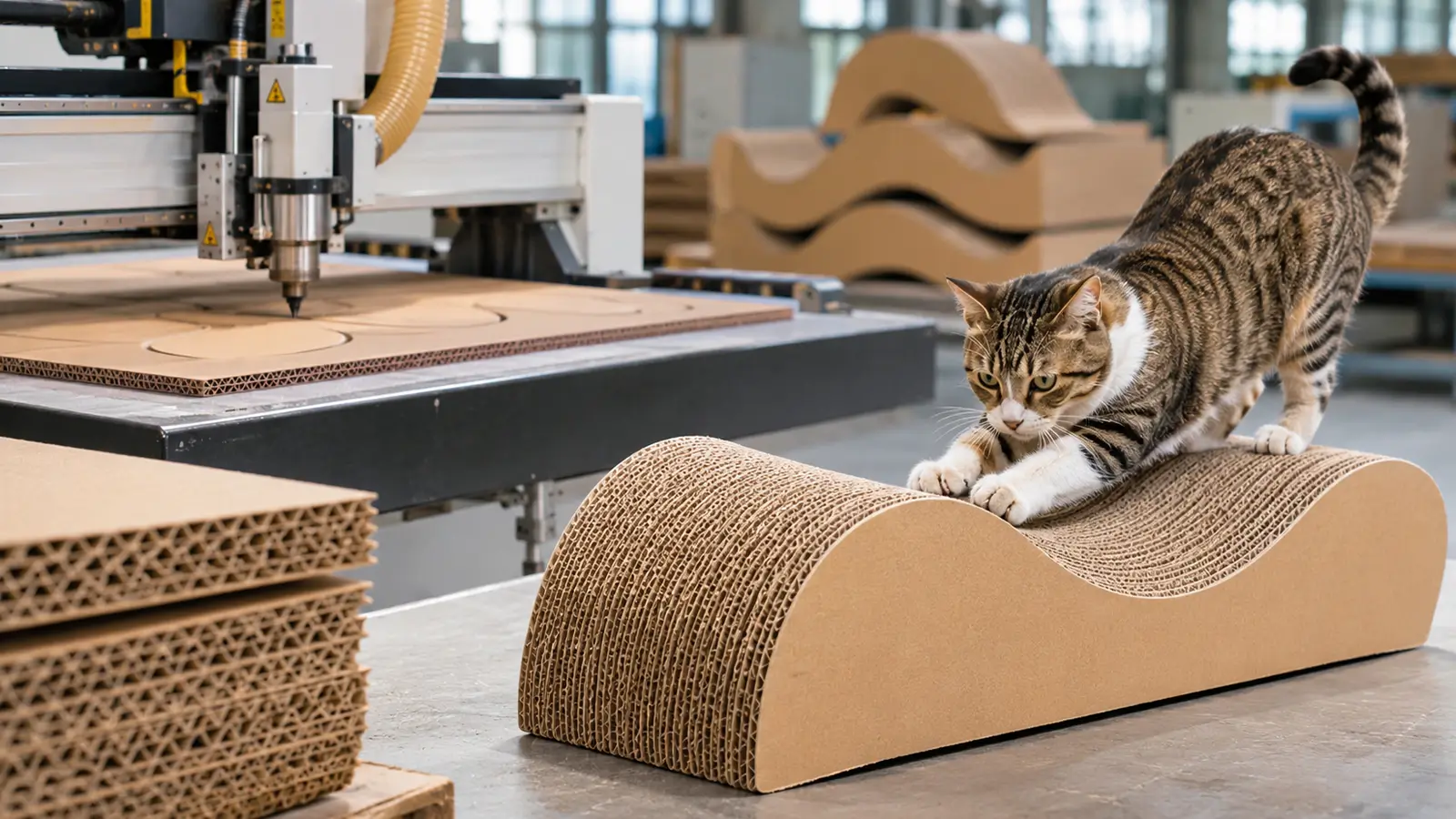
A corrugated cat scratcher starts as corrugated cardboard — the same fluted material used in packaging — pressed into dense, thick boards for pet use. The fluting, the wavy inner layer, gives the board its strength and texture: a cat’s claws catch the exposed flute edges, which is exactly what makes a scratcher satisfying to use. As a rule, the thicker and denser the board, the longer the scratcher lasts.
- Cutting and Shaping
Modern factories cut scratcher shapes with CNC engraving machines, which follow a digital pattern to cut curves, waves, and furniture shapes precisely and repeatably. A factory running 20 CNC engraving machines can cut consistent shapes at volume — and consistency matters, because a scratcher cut cleanly holds its shape, while a roughly cut one frays at the edges. The partner factory we work with in Qingdao, which has spent about 10 years on corrugated cat scratchers and pet furniture across a 5,500 sqm workshop, cuts every shape on CNC for this reason.
- Gluing and Pressing
Workers glue and press the cut layers into a solid block. The glue has to be strong enough to hold the layers together under daily scratching, and — because cats lick and chew — it has to be non-toxic and pet-safe. For that reason, buyer should ask a supplier: what glue do you use, and is it certified safe for pets?
- Finishing
The block is trimmed, the edges are cleaned up, and any printed or decorative finish is applied. Some scratchers are plain kraft; others are printed, dyed, or shaped into furniture — a sofa, a lounge, a house. The finish is where design meets durability: a printed surface looks better on a shelf, but it must not flake off under claws.
What to Check Before You Buy Corrugated Cat Scratchers
Fortunately, You do not need a factory tour to judge a scratcher. Four quick checks tell you most of what you need to know:
- Board Density
Press the surface. A dense board resists the press and springs back; a soft, low-density board compresses and stays dented.
- Cut Quality
Look at the edges. Clean, sharp cuts mean the shape will hold; ragged or crushed edges mean the board will shed and fray.
- Glue
Ask whether the adhesive is non-toxic and pet-safe, and whether the factory can provide a test report.
- Consistency
Order a sample, then order again. A good factory produces the same scratcher every time; a poor one varies from batch to batch.
How Pet Stores Source Corrugated Cat Scratchers
Most pet stores buy through a distributor or directly from a manufacturer. Buying direct from a manufacturer — or through a sourcing agent who works with one — gives you control over design, private labeling, and price. It also means you carry the quality-control responsibility, so the checks above matter more, not less.
- OEM and ODM
Many factories offer both. OEM means they make your design; ODM means they offer their own designs that you can brand as your own. On the other hand, if you want a scratcher shape no one else has, OEM is the route. If you want proven sellers quickly, ODM is faster.
- MOQ and Lead Time
Ask the minimum order quantity and the production lead time before you commit. In most cases, a factory that is transparent about MOQ and lead time is usually transparent about quality too.
- Factory Check
If you can, ask for a factory video or a virtual tour. A real factory with real machines — CNC engravers, pressing lines — is a good sign. In contrast, a supplier who cannot show you the factory is a red flag.
The Bottom Line
A corrugated cat scratcher is a simple product, but it is not a commodity. The factory makes the difference between a scratcher that lasts and one that falls apart, through the board, the cut, the glue, and the pressing.Buyers who understand that process, and who ask the right questions of their supplier, end up with a product their customers come back for.
FAQS – Corrugated Cat Scratchers
Corrugated cat scratchers match how cats naturally scratch. The fluted edges catch claws, and the layered board lets a cat stretch fully. Scratching also leaves a scent mark from glands in the paws.
Shipping corrugated cat scratchers from China typically takes 25 to 45 days by sea freight, depending on the port. Air freight takes about 5 to 10 days but costs more.
Board thickness, shape complexity, print finish, packaging, and order size set the wholesale price of corrugated cat scratchers. Thicker, denser boards cost more but last longer. Larger orders lower the price per unit.
Sign a non disclosure agreement before you share artwork or custom shapes for corrugated cat scratchers. Ask the supplier to confirm in writing that your design stays exclusive to you. Register your trademark in your selling market, and keep your original files.
Corrugated cat scratchers often work well for pet stores. The unit cost is low, and the product wears out, so customers come back for replacements. Pair them with catnip or a lounge style range to raise the basket size.