
Badge Icon General Listing

FISHBIO

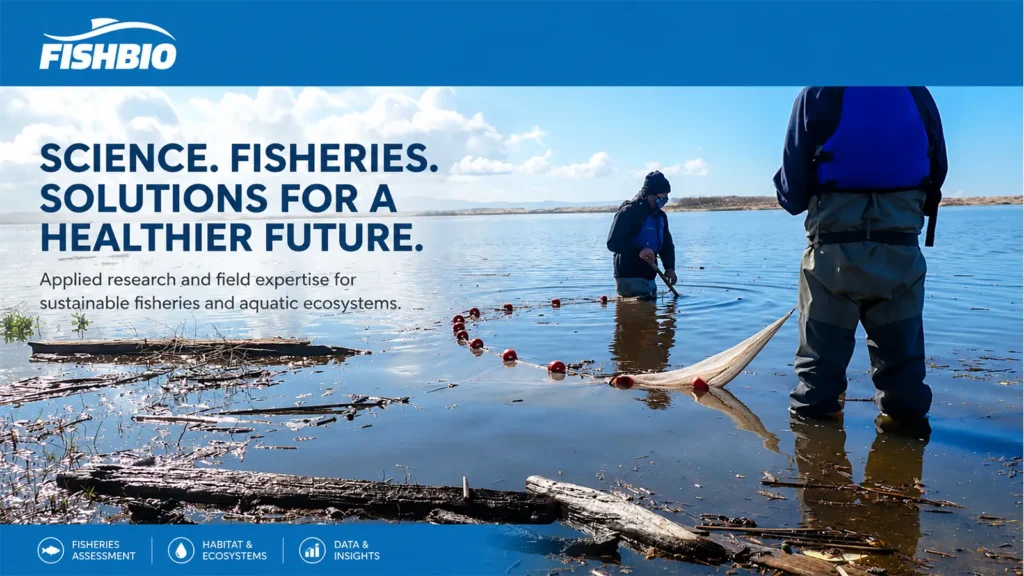
FISHBIO is a fisheries and environmental consulting company that researchers, resource agencies, water districts and conservation groups hire to study, monitor and help protect wild fish populations rather than a service for home aquarium owners. Founded in 2006 in Oakdale, California, the company now operates from offices in Chico and Oakdale plus a location in Vientiane, Laos, giving it an operational footprint that spans California’s Central Valley and the Lower Mekong Basin in Southeast Asia. FISHBIO structures its work around five core services, research, monitoring, conservation, fabrication and communication, and its multidisciplinary staff includes fisheries biologists, engineers and technicians who build much of their own field equipment in house.

That fabrication capability sets FISHBIO apart from many fisheries consultants who rely entirely on off the shelf gear. The company designs and builds custom fish traps, resistance board weirs and PIT tag antenna systems, and its technology lineup spans acoustic tracking and PIT tags, ARIS and DIDSON imaging sonar, drones and custom cameras, fyke traps, rotary screw traps and electrofishing gear, plus a molecular lab for eDNA species detection and genetic sample analysis. FISHBIO also maintains an onsite fish lab with aquariums and tanks for controlled equipment studies. In Southeast Asia, the team works on community based fish conservation zones and capacity building projects throughout the Mekong Basin, alongside its longer running California salmon and steelhead monitoring work. FISHBIO also publishes The Fish Report, a weekly newsletter covering fisheries news and its own research findings, and shares its peer reviewed publications and field work through its blog and multimedia archive.

Frequently Asked Questions

What is the difference between a fisheries biologist and a marine biologist?

A fisheries biologist typically focuses on fish population dynamics, harvest management and the health of specific fish stocks, often in freshwater or managed fisheries, while a marine biologist studies the broader ocean ecosystem, including species that are never targeted by fishing. The two fields overlap heavily, and many professionals move between them depending on the project.

Why do researchers use PIT tags to track fish instead of GPS trackers?

PIT tags are small, passive microchips that never need a battery and can identify an individual fish for its entire lifespan once implanted, while GPS trackers are larger, need power and work poorly underwater since GPS signals do not travel well through water. PIT tags instead rely on antennas placed in rivers or fish ladders that detect a tagged fish as it swims past.

What does environmental DNA, or eDNA, testing actually detect in a river or lake?

eDNA testing analyzes water samples for tiny fragments of genetic material that fish and other aquatic species shed into their environment through skin, waste and mucus. It lets researchers confirm which species are present in a body of water without ever having to catch or see the fish directly.

Why are rotary screw traps used to count young salmon in rivers?

A rotary screw trap uses the river's own current to spin a cone shaped drum, funneling migrating juvenile fish into a live box where researchers can count, measure and release them unharmed. It gives a consistent, repeatable sample of how many young fish are moving downstream during a given period, which is difficult to estimate through observation alone.

What role do private fisheries consultants play alongside government agencies like fish and wildlife departments?

Private consultants are often hired to conduct specialized fieldwork, build custom monitoring equipment or run long term studies that stretch beyond what an agency's own staff and budget can cover in house. Their findings and recommendations typically feed into the regulatory and management decisions that government agencies ultimately oversee.