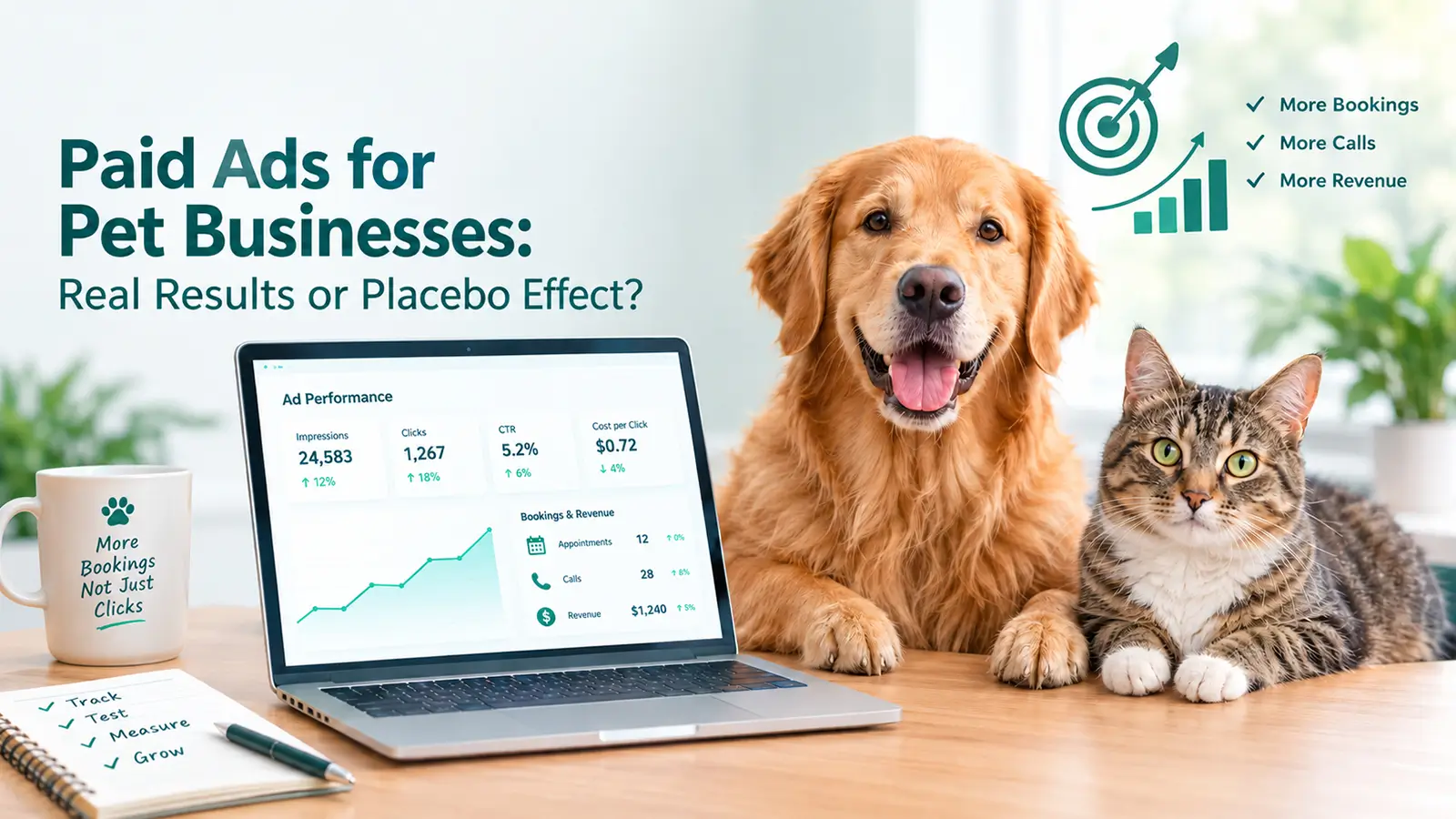
Paid ads for pet businesses often deliver a feeling of progress long before they deliver revenue. The dashboard glows. Clicks climb. Impressions stack up by the thousands. The owner feels busy and smart. Then the month ends, and the appointment calendar looks exactly like it did before the campaign launched.
That gap between feeling and fact has a name: the placebo effect.
This guide explains how the illusion shows up in pet business advertising, which signals separate real growth from comfortable fiction, and how any owner can test a campaign without a marketing degree. The first step is a precise definition of what the illusion looks like inside an ad account.
What the Placebo Effect Means for Paid Ads for Pet Businesses
In medicine, a placebo is a sugar pill. Patients swallow it, feel better, and credit the treatment, even though the pill contains nothing active.
Advertising produces a similar trick. The placebo effect happens when ad spend feels productive while the revenue would have arrived anyway. The clicks are real, but credit is the problem.
Pet businesses fall into this trap easily.
Pet owners search for care at emotional moments, so demand already exists in most local markets. The numbers confirm it:
U.S. pet industry spending reached $158 billion in 2025, and the American Pet Products Association (APPA) projects $165 billion for 2026, with about 95 million U.S. households owning a pet. With that much demand already in motion, a groomer, a boarding facility, or a trainer often wins steady business through reviews, referrals, and a strong Google Business Profile.
When ads switch on, some of those same customers click the paid link instead of the free one. The platform records a win, and the business pays for a customer it already had. The numbers that make this illusion so convincing deserve a closer look, because most of them measure activity instead of income.
Why Vanity Metrics Fool Pet Business Owners
Ad platforms report what they can measure easily: impressions, clicks, click through rate, and cost per click. These numbers describe activity. They do not describe outcomes.
A pet business earns money from booked grooming appointments, boarding reservations, training enrollments, and product orders. Every number upstream of those events deserves suspicion until it connects to a sale.
Consider a hypothetical dog trainer who launches a campaign and watches 400 people visit the website in a month. The report looks impressive. Then the trainer counts enrollments: six new clients, and four of them mention a neighbor’s recommendation. The ads touched the journey, but they may not have created it.
The metrics that deserve attention instead:
- Cost per booked appointment, reservation, or order
- Phone calls that turn into paying customers
- Revenue earned for every dollar of ad spend, known as return on ad spend
- The share of new customers, not returning
What Industry Benchmarks Hide
Industry benchmarks show how flattering the numbers behind paid ads for pet businesses can look.
WordStream’s 2026 benchmarks draw on more than 13,000 search campaigns that ran between April 2025 and March 2026, and they put the Animals & Pets average cost per click at $4.06. The same category posted the highest conversion rate of any industry, at 16.22%. A platform conversion is not a booking, though. Google’s own Help documentation explains that a click on a phone number on a mobile site counts as a call conversion, even though Google tracks only the click and not the call itself.
Consider a hypothetical boarding facility that pays the category average cost per lead of $31.50. If one in three leads books a stay, each booked stay costs about $94.50 in ad spend. If half of those stays would have happened without the ads, each stay the ads truly created costs about $189.
Those two assumptions illustrate the math. They do not come from the benchmark data. Even with the right metrics in place, one campaign type fools owners more often than any other.
Branded Search: Paying to Greet Customers Who Already Know the Name
Branded search campaigns show the placebo effect in its purest form. The business pays to appear when someone types its own name, such as “Happy Paws Grooming near me.” That person already knows the business. In many cases, the free listing directly below the ad would have earned the same click.
Recent testing supports that caution, with an important twist. In a September 2025 analysis of branded search experiments on Google, the measurement firm Haus found that 82% of brands facing high competition on their own name measured significant lift, against 35% of brands facing low competition. In plain terms, ads in the high competition group caused roughly 37% of the sales the platform reported, while ads in the low competition group caused roughly 9%. The experiments covered online retail brands, so a local pet business should treat the numbers as a guide, not a rule.
However, branded campaigns still have a place. They block competitors who bid on the business name, and they help when rivals crowd the results page. The test is simple. Pause the branded campaign for a few weeks and watch bookings. If calls and appointments hold steady, the campaign collected credit without creating customers.
Remember, branded search is only one place where credit lands in the wrong spot. Tracking gaps cause the same problem across the entire account.
The Attribution Gap: Where Calls and Walk Ins Disappear
Now this is really important: Attribution decides which marketing effort gets credit for a sale. Pet businesses leak attribution data constantly. One customer sees an ad, then calls the front desk. Another walks in after spotting a van wrap or a friend’s Instagram post. A third books online after three weeks of quiet research.
When the business tracks none of this, the ad platform fills the silence. It claims conversions it did not cause, or it misses calls it did drive. Both errors lead to bad decisions: cutting a campaign that works, or feeding one that does not.
Fixes cost little:
- Dedicated tracking phone numbers on ads and landing pages
- A standard intake question, “How did you hear about us?” logged for every new customer
- Conversion tracking for form submissions, online bookings, and click to call taps
- A monthly review, because daily numbers swing too widely to trust
Google Ads supports five ways to track phone call conversions, including importing calls from another system so that only calls tied to a sale count. Advertisers can also set a minimum call length before a call qualifies.
Yet, clean tracking also exposes a factor that shapes every result: where the business sits in its local market.
Local Intent Changes the Math
Local service businesses win on proximity and trust. Someone searching “emergency vet near me” or “dog boarding near me” cares about distance, reviews, hours, and photos. A well maintained Google Business Profile, steady review growth, and accurate listings often carry more weight than a paid placement.
Google states that local results rest mainly on relevance, distance, and prominence, and that no one can pay for a better local ranking. Reviews feed that prominence. BrightLocal surveyed 1,002 US adults in February 2026. It found that 97% of consumers read reviews for local businesses, and 41% now always read them, up from 29% a year earlier. BrightLocal research also found that only 35% of small businesses have a Google Business Profile, so a claimed and complete profile still counts as an edge. The survey lists Google, Facebook, and AI tools such as ChatGPT as the most common sources of local recommendations in 2026.
That does not make paid ads for pet businesses useless. It means the baseline matters. A business with a thin profile and few reviews may see ads work hard, because paid placement fills a visibility gap. On the other hand, a business with a strong local presence may see ads add far less than expected. Owners who strengthen the free foundation first learn what ads truly add on top.
But search ads are not the only place where the baseline question matters. Social platforms raise it too.
The Same Trap on Meta, Instagram, and TikTok
Social platforms create their own version of the illusion. Likes, shares, video views, and follower spikes feel like momentum. For example, a puppy reel can rack up views while the booking calendar stays empty.
No doubt, social ads excel at awareness and discovery, especially for pet brands that sell products people never search for by name. However, awareness only counts when it leads to a purchase or a booking within a reasonable window. Owners should hold social campaigns to the same standard as search: did new customers arrive who would not have arrived otherwise?
Meta now calls Conversion Lift the gold standard of measurement. Its developer documentation also notes that Conversion Lift access is limited and requires a Meta representative. Many small pet businesses lack one, so a simple geo or pause test usually fills the gap.
When Paid Ads for Pet Businesses Genuinely Work
Paid ads for pet businesses earn their budget in specific situations. For example:
- Urgent services. Emergency vet care, same day boarding, and lost pet support attract searchers who need an answer now, and a top placement wins the call.
- Premium priced services. When one new client brings hundreds of dollars or ongoing revenue, a higher cost per lead still pays off.
- New market launches. A second location or a new city lacks reviews and recognition, so ads create visibility that does not exist yet.
- Online pet brands with solid tracking. Stores with clean conversion data can measure return on ad spend and scale what performs.
- Seasonal spikes. Holiday boarding and summer grooming reward timely campaigns.
Even in these favorable situations, an assumption falls short of proof. Every campaign still needs a test.
How to Test Whether Ads Create Real Results
Testing paid ads for pet businesses requires patience, not technical skill. The goal is to measure incremental lift, which means the extra bookings that exist because of the ads.
- Set a baseline. Record bookings, calls, and revenue for four to six weeks of normal activity.
- Change one variable. Pause a single campaign, such as branded search, or switch ads off in one service area.
- Keep a comparison. Leave another campaign, area, or time period running as usual. A geo holdout test applies this logic across locations.
- Give the test time. Two to four weeks usually smooths out weekday swings, though seasonal peaks can distort results.
- Compare outcomes. If bookings hold steady without ads, the ads added little. If bookings drop sharply, the ads earn their place.
- Decide and repeat. Cut, keep, or reshape the campaign, then test the next one.
What Google and Meta Say About Testing
Google describes Conversion Lift as a controlled experiment that splits an audience into two groups and measures the extra conversions the ads cause. Not every Google Ads account can use it, and some accounts must contact a Google representative first, so manual pause and geo tests matter for small businesses. One industry summary of Google’s guidance sets a seven day minimum and recommends fourteen days, because shorter tests can understate lift when customers take time to convert. Boarding bookings often arrive weeks ahead, so tests of paid ads for pet businesses should lean toward the longer end.
Owners on tight budgets can start with the smallest campaign to limit risk.
What the Test Results Reveal
A pause test of paid ads for pet businesses usually lands in one of three outcomes, and each one points to a clear next move.
- Bookings hold steady. The campaign mostly collected credit. The owner can cut the budget or shift it to a channel with a stronger record.
- Bookings fall a little. The ads add some value, but possibly not enough to justify the full spend. Trimming the budget or tightening the targeting can improve the return.
- Bookings fall sharply. The campaign creates real customers. The owner can protect that spend and test ways to scale it.
Whatever the outcome, the result belongs to the business, not to the platform’s dashboard. That ownership separates informed advertising from hopeful advertising.
Final Thoughts on Paid Ads for Pet Businesses
Paid ads for pet businesses work best when owners measure outcomes instead of activity. Clicks and impressions create a comfortable feeling, but only bookings, calls, and revenue prove growth. Smart owners track every lead, test every campaign, and build a free foundation of reviews, accurate listings, and trust that keeps customers arriving whether the ads run or not.
APPA reports that 22% of pet owners spent less on their pets in 2025, so value seeking is rising and every wasted ad dollar costs more. Google also notes that prominence draws on information from across the web, including links, articles, and directories, so a complete directory profile can contribute to that free foundation. Industry events add another route to new customers beyond paid ads, and the PETBIZS Pet Industry Events & Expos page lists upcoming pet industry events.
That foundation starts with being easy to find. PETBIZS gives pet businesses a trusted home where pet owners discover them, with a business profile that builds credibility around the services behind it. Claim your business profile on PETBIZS today and start earning attention that never depends on an ad budget.
Written by Jehanzaib Ahmed, Founder & CEO of PETBIZS