
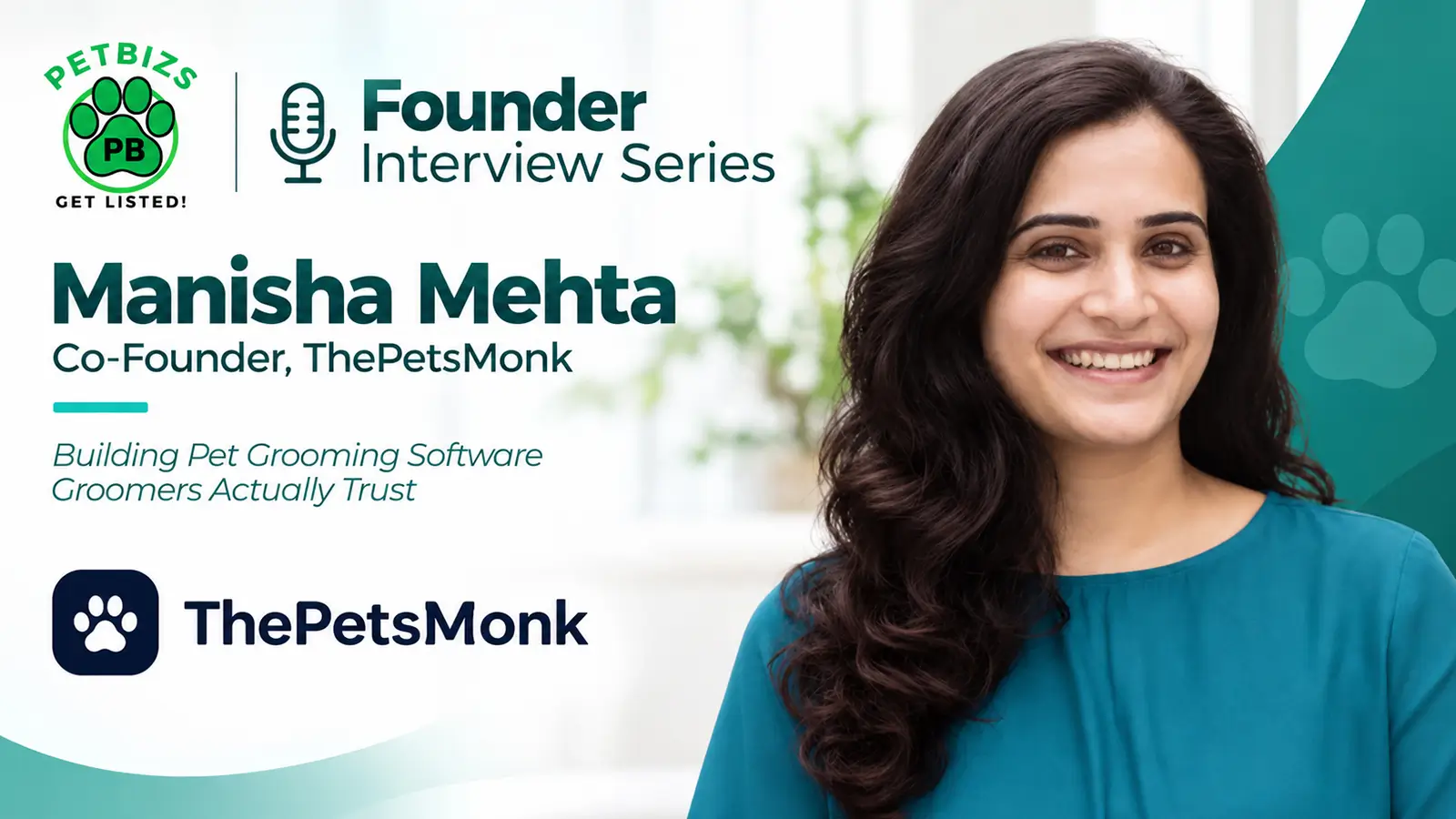
Pet grooming software often misses the one place it matters most: the salon floor. A groomer stands with wet hands, a dog shaking off the tub, and a phone that keeps buzzing. Meanwhile, the booking tool on the screen knows nothing about any of it.
Manisha Mehta saw that gap up close. She and her ThePetsMonk team chose to close it by working beside real groomers and rebuilding features until they matched the day.
In this conversation, she explains why paper and sticky notes keep winning and what her team had to unlearn. She also shares why a free basic plan gives every groomer an easy start.
Thank you for joining PETBIZS, Manisha. You co-founded ThePetsMonk to give working groomers free pet grooming software built around how a real salon actually runs, not how a generic booking tool thinks it should. Can you introduce yourself and share what first convinced you and your team this problem was worth solving?
Thanks for having me. I’m Manisha, co-founder of ThePetsMonk. We build grooming software, plus daycare tools, so a salon can run its whole day in one place. We also offer a free basic plan to start.
What convinced us was how far generic booking tools are from a real salon floor. Groomers deal with breed-specific triming, coat and behavior notes, add-ons, and no-shows, all with their hands full. Most end up on paper and texts. We wanted software that fits the salon, with an easy way to start.
Your team had already built FreshLearn, Growth Robotics, and RevX before ThePetsMonk. What made you decide grooming was the next problem worth solving?
After FreshLearn, Growth Robotics, and RevX, we knew how to build for small businesses.
Grooming found us, in a way. While working on FreshLearn, we made a connection with a grooming salon, and seeing how it actually ran inspired us. We saw skilled owners doing everything by hand, with tools that weren’t built for them. That felt like the right next problem.
A lot of groomers still run their whole business on paper and sticky notes. Why do you think pet grooming software took so long to actually fit how a real salon works?
I think most software builders focused on the booking, not the salon. A groomer’s day is full of things a calendar doesn’t capture: breed-specific timing, coat and behavior notes, add-ons, and a dog that runs late.
So tools felt like extra work, and paper and sticky notes stayed faster. Real salons run on repeat clients, so we built recurring appointments that keep regulars booked without the back-and-forth. And with in-app chat, groomers and pet parents talk in one place instead of scattered texts and calls.
You chose to build slowly with working groomers instead of shipping fast with what your team already knew. What did that slower path actually cost you early on?
Honestly, it cost us speed.
We could have shipped faster with what we already knew. Instead, we slowed down, listened, and sometimes rebuilt things we thought were finished. But it was a wonderful experience, because we were learning something new every day. Working with groomers taught us how a salon really runs, and that made the product better than anything we’d have rushed out.
ThePetsMonk brings together booking, reminders, payments, and reports in one place. What convinced you pet grooming software needed to replace nine separate subscriptions instead of doing just one thing well?
Because a salon doesn’t run in pieces. A groomer’s day connects everything: a booking leads to a reminder, then a payment, then a report. When each step lives in a different app, the groomer becomes the glue, copying details between tools and paying for each one. We chose one place for it all, so the information flows on its own and the salon saves both time and money.
You offer ThePetsMonk free forever for solo groomers, with no credit card required. Why did you decide solo operators shouldn’t have to pay at all?
We’re still finalizing our pricing plans, so I won’t promise more than I can stand behind. What I can say is that we offer a free basic plan so groomers can start without a barrier, and solo operators are often the most stretched, doing everything themselves. Some features, like messaging, cost real money to run, so they aren’t part of the free plan. Our goal is fair, simple pricing, shaped with groomers’ feedback.
Salons with two or more staff get honest, flat pricing instead of a per seat charge. How do you think about pet grooming software pricing that doesn’t punish a salon for growing?
Growth should feel like good news for a salon, not a bill. When the price goes up with every groomer you hire, the software starts to feel like a penalty for success. So we keep pricing simple and predictable, so a salon can add staff without doing math or facing surprises.
We’re still shaping the plans with groomers’ feedback, but that’s the principle behind them.
You say working groomers are advisors and beta partners who shape your roadmap. What’s an example of a feature that only exists because a groomer pushed back on your original plan?
Two features come straight from groomers: recurring appointments and card on file.
Groomers told us their day runs on regulars, and that chasing payments and rebooking the same clients over and over eats their time. So we built recurring appointments to keep regulars booked, and card on file, so groomers can take payment without an awkward moment at the counter. Both exist because groomers pushed us to build around how a salon really works.
Your migration team moves a salon’s customers, pets, and history over in under a week with zero data lost. Why did switching pet grooming software need to feel that effortless?
Because the biggest fear a groomer has about switching is losing their data: their clients, their pets, their history. If that feels risky, they stay on paper. Our experience building FreshLearn, a large product with high-end technology, taught us how to move data safely at scale. We brought that same discipline to ThePetsMonk, so a salon can switch smoothly and trust that nothing gets lost.
You build automated reminders and a shared inbox across WhatsApp, SMS, and email right into your pet grooming software by default. How much of a groomer’s day actually disappears into those channels before ThePetsMonk shows up?
A lot of it, honestly.
Confirmations, reminders, rescheduling, and “are you running late?” messages all happen between grooming sessions, usually with wet hands. Each one is small, but they add up across a day. So we built automated confirmations and reminders into ThePetsMonk, including WhatsApp, so they go out without the groomer typing anything.
Right now those messages go out under the ThePetsMonk name, and the groomer’s time goes back to the dogs.
You report a twenty two percent average rebooking lift across salons using ThePetsMonk. How much of that comes down to the pet grooming software itself versus just reminding people more consistently?
That number comes from testing with two running salons, so it’s an early result. Reminders do a lot of the work, but the software helps too: recurring appointments keep regulars booked, and card on file removes friction. With a sample this small, we can’t fully separate the two yet, and we’ll measure it better as more salons join.
Your FAQ promises setup in under an hour with no training calls or consultants. What had to be true about the product for that kind of onboarding to actually work?
Setup is quick because we built the product around what a salon already does: add services, add staff, bring in clients, and start booking. There are no training calls or consultants, because nothing should need explaining twice. If a groomer needs a manual to get started, we haven’t done our job.
A groomer in your testimonials went from working solo on the free plan to running five groomers and three hundred appointments a month. How does pet grooming software need to change as a shop scales like that?
As a shop grows, the software has to take on more of the work: multiple staff calendars, clear roles, and reports, while staying simple. A growing salon shouldn’t have to switch tools or learn a whole new system. It should grow with them.
You built pet profiles into your pet grooming software that include vaccinations, notes, and behavior flags, things like reactive to dryer or new rescue, slow. Why did that level of detail matter enough to build in from day one?
Because a groomer’s safety and the pet’s comfort depend on it. Vaccinations, notes, and flags like “reactive to dryer” or “new rescue, go slow” mean any groomer on the team can handle a pet the right way, even on their first visit.
ThePetsMonk also powers daycare and boarding businesses, not just grooming. How much of the same pet grooming software logic carries over to a kennel that’s never touched a clipper?
More than people expect.
Pet profiles, vaccinations, bookings, reminders, and payments work the same way. However, the differences are things like stays and capacity, but the foundation carries over.
You’re a partner of the Texas Professional Pet Grooming Association. What does a relationship like that actually look like day to day, beyond just a logo on your site?
We’re a sponsor of TPPGA. Day to day, it means showing up for members. For example, we hosted a virtual intro and demo webinar for them on September 27. We listen to what Texas groomers need and take it back to the product.
A lot of groomers are genuinely not tech savvy, by your own FAQ’s admission. How do you design pet grooming software for someone who’s never used an app like this before?
We design for someone who’s never used an app like this. That means few steps, plain words, big buttons, and a layout that matches how a groomer already thinks about their day. If it needs a manual, we’ve failed.
Your platform claims ninety eight percent uptime and over two million dollars in revenue managed. How do you personally keep a founder’s eye on numbers like that without losing sight of the groomer on the other end?
Numbers matter, but behind each one is a groomer’s day. I stay close to groomers directly, through feedback and conversations, so the metrics never replace the people they represent.
You promise encrypted data, regular backups, and full data export if someone ever wants to leave. Why did building trust around pet grooming software mean making it easy to walk away, not just easy to join?
Because trust means groomers own their data. Encryption and backups protect it, and export means they can take it with them anytime. When people know they can walk away, they stay because the product earns it.
Your team competes directly against pet grooming software like MoeGo, Gingr, and Pawfinity. What do you think those comparisons usually miss about what a working groomer actually needs?
Comparisons usually list features. A working groomer cares about how the day actually flows: recurring regulars, payments, messaging, and whether it’s easy enough to use between dogs. We built around that.
As more solo groomers and small salons look for their first real system, how do you see pet grooming software changing the baseline for what a one person shop can actually run on?
A one-person shop can now run on a real system for bookings, reminders, payments, and client history, not a notebook. That raises the baseline for the whole industry.
If a groomer reading this is still managing bookings through a notebook and a ringing phone, what would you want them to try first before anything else?
Start small: put your regulars on recurring appointments and let reminders go out automatically. That one step usually cuts the phone calls and no-shows.
You built this company around your own dog Biscuit’s groomer struggling in real time. How often does a moment that personal actually turn into real pet grooming software decisions months later?
Quite often. Seeing how a real salon runs, and how much of the day goes to the small stuff, stayed with us long after that first visit. It shaped decisions months later, like recurring appointments, card on file, and messaging built right into the app.
What’s one assumption about how groomers work that your own team had to unlearn once you started building alongside them?
We had to unlearn how little time a groomer has. They’re hands-on all day, so anything that needs a desk and a long form gets skipped. That’s why we keep everything fast and simple.
As we wrap up, what do you want groomers everywhere to understand about the future of pet grooming software, and the kind of support you think every working groomer deserves?
Groomers are skilled professionals who deserve tools that respect their time and their craft. The future of grooming software is simple, fair, and built with them, not just for them.
Lets Wrap Up!
Thank you, Manisha, for showing how ThePetsMonk turns pet grooming software into a tool that respects a groomer’s time. Your answers made the case clear and showed that a salon can switch in under a week and take its data along whenever it wants.
If a notebook and a ringing phone still run your salon, start where Manisha suggests: visit thepetsmonk, try the free basic plan, and move your regulars onto recurring appointments.
And if your pet business has a story worth telling, contact PETBIZS for your own founder interview.