
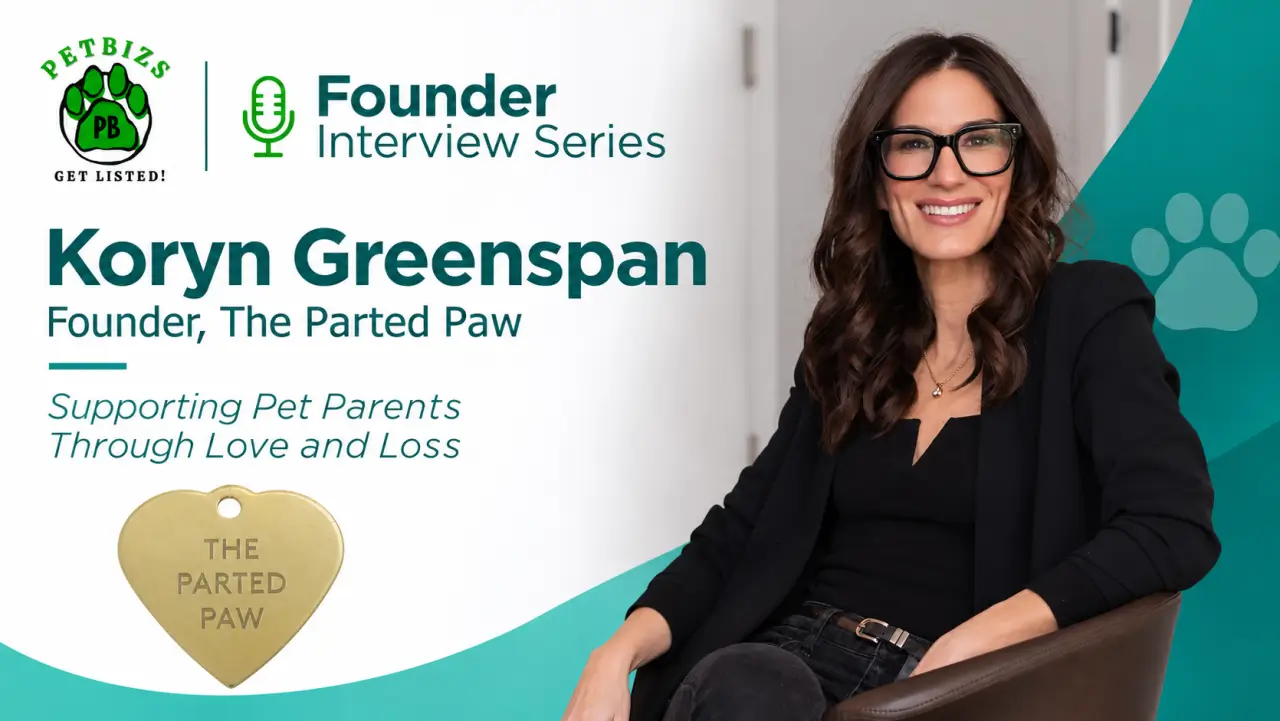
Pet loss support where “just get another one” is never the answer, because the love you lost was never replaceable.
Pet loss support was nearly absent when Koryn Greenspan needed it most. After her sister Joy passed away in 2021, family, friends, and community surrounded her. A year later, when her rescue dog Georgia died, the response was “almost crickets,” in her words. That silence became The Parted Paw.
In this PETBIZS interview, Koryn explains why a pet parent’s grief deserves the same recognition as any other loss. She also shares how she guides families, couples, and workplaces through guilt, goodbyes, and everything that comes after.
Thank you for joining PETBIZS, Koryn. You built The Parted Paw into one of the first dedicated pet loss support services. Can you introduce yourself and share what led you here?
My name is Koryn Greenspan, and I’m the founder and owner of The Parted Paw. I’ve been an entrepreneur in the pet industry for around 15 years, and it all started with my rescue dog, Georgia. Georgia had a hard start to this life and came to be as an abused dog who was struggling to feel comfortable in the world. I completely fell in love with her, and I wanted to build a life where I could give her the support she needed.
At the time, I was working in public relations, in a career I didn’t love. So, I left and started a dog walking company in Toronto. Georgia and I built that business together, and it grew to include boarding, training, puppy care and socialization.
In 2021, tragically, my sister Joy passed away from brain cancer. I had never experienced a loss like that, and I realized I couldn’t manage a large business while trying to understand my own grief. I sold the company and took time for myself.
1 year later, when Georgia later passed in a traumatic emergency, I experienced another profound loss, but a very different response. After Joy’s loss, there had been family, friends, community, religious and professional support, all of which I was so grateful for. After Georgia, there was very little. It was almost crickets.
Having experienced bereavement through those two very different lenses, I thought, we have to do this better. I returned to school, continued studying grief and end-of-life support, and created The Parted Paw. I’m still studying today, working towards becoming a thanatologist.

You noticed a painful gap in pet bereavement support before you started. What did that gap look like to you?
In my previous company, I had the privilege of being part of a pet’s life from puppyhood through their teenage years, adulthood, senior years, and, eventually, end of life. You also become part of that family’s life. Over the years, I saw how profoundly those goodbyes affected pet parents, and how often they felt they had neither the preparation nor the support to know what to do.
No two experiences were the same. But the lack of understanding around them kept appearing. Then I lost Joy and Georgia, and that difference in how people responded became very personal.
As I studied pet loss, grief and doula work, I began finding language for what I had been seeing. Disenfranchised grief was a significant part of that: people experiencing profound bereavement without their loss being adequately recognized or supported. There was such discomfort around pet loss, even though the love was so evident. That disconnect was impossible for me to ignore.
Many people have never heard of a pet loss specialist. How would you describe it to a first time visitor?
The Parted Paw supports pet parents before, during, and after a beloved pet has parted. I also work with veterinary and pet care professional teams, because they are affected by these losses too.
Before a pet has parted, we work with anticipatory grief alongside the practical questions that are so difficult to ask. What would you like end of life to look like? Who do you want there? What needs to be arranged? What support will you need afterwards? As an end-of-life doula, I help families document their wishes, communicate with their veterinary team, and prepare. I’m also, at times, asked to be there at euthanasia appointments or stand in for pet parents who simply are unable to be there themselves.
Immediately following a loss, there is often so much raw emotion with nowhere to go. Someone might not know how to explain what they are feeling, or might feel embarrassed by how profoundly they have been affected by their pet’s passing. Those early sessions give them time to speak, cry, and express their loss without having to apologize for it.
As we continue, we begin working with what is happening beneath that initial sadness. That includes guilt, regret, changes in identity, and the loss of everyday routines and connection. We look at where their grief is showing up, what they need to understand about it, and how they want to carry their connection with their pet into their life.
There is work between sessions too. Working with grief takes thought, effort, presence, and reflection. There are moments for stillness and moments for action. Through that type of work, we begin learning how to coexist with love and loss at the same time.
You separate grief, mourning, and bereavement into three different experiences. Why does that distinction matter to pet parents?
I love this question because having language for what is happening helps pet parents understand their own experience. Bereavement is the experience of having lost or being torn apart by the loss of life. From someone we love. Grief is our response to that loss, and mourning is how we express it outwardly. In my work, I also talk about going from grief to grieving.
I describe acute grief through a photograph on your phone. Imagine zooming right in until one part fills the entire screen. The rest of the picture disappears. That is how consuming early grief often feels. The rest of the world is still there, but relating to it feels very difficult.
When I talk about moving from grief to grieving, I’m describing the work of attending to the internal experience. We begin identifying and understanding the feelings attached to the passing of our pet. We spend time with what happened, what we are carrying, and what needs expression. Gradually, the view widens, and more of the picture comes back into focus.
Mourning connects that internal experience with how we express our love and loss in the external world. Memorialization, rituals, and remembrance become ways to continue that connection. We begin seeing our pet’s life and our life together in a greater capacity, rather than only the circumstances of their passing. This is where we begin to learn that there is room for peaceful, loving memory alongside the sadness of their loss.
These experiences often overlap, and distinguishing amongst them helps us understand what someone needs when they say they feel stuck. Their feelings might need expression, understanding, acknowledgment, or a way to maintain connection.
Grief is not something we need to fix. It becomes something we continue to grow with, learn from, and live with. We are learning how to move with our loss.
Anticipatory grief starts long before a pet dies. When should pet loss support begin for a family?
Support ought to begin at any time. Even when a pet is well, there is value in knowing what you would do in an emergency and what decisions you might face. When you have a senior pet or a terminal diagnosis, those conversations become especially important.
For example, some pet parents have never heard of in home euthanasia. Others feel more comfortable having their pet’s end of life take place at their veterinary clinic. We talk about those preferences, along with cremation, aquamation, burial, memorialization, and any of their pet’s belongings they would like to keep. We also consider who will support them afterwards, including at work.
These are deeply personal decisions. Thinking about them ahead of time gives a family the opportunity to understand their options and their wishes before an emergency makes everything more difficult.
No amount of planning makes you fully prepared to lose your pet, ever. But it does give you a clear-er understanding of what you would do, with fewer decisions to make in that moment. That leaves more of your attention available for being with the pet you love.
Many pet parents hide their grief from employers and friends. Why does disenfranchised grief hit pet loss so hard?
Because a pet parent has already experienced a profound loss and then has to navigate whether anyone around them will recognize it. That expectation comes from society. It shows up in families and friendships, and it is especially evident at work.
In Ontario, statutory bereavement leave does not include pet loss. Unless a workplace offers broader support, employees are left trying to arrange other time away or return while they are struggling. Some use vacation days and some take unpaid leave. And even some don’t tell their colleagues their pet has passed because they worry about the response.
I have worked with people whose employment has been affected because they were unable to function and did not have the support they needed. There are financial consequences, but there are also consequences for trust. How do you feel about a workplace that asks so much of you, yet does not acknowledge one of the most profound losses in your life?
That lack of recognition adds resentment, isolation, and hurt to an already deeply painful experience. It is like pouring salt on a wound. Pet parents need the loss itself acknowledged, along with practical support to help them through it.
You support individuals, families, couples, and workplaces. How does this change for each group?
With individuals, I often hear, “I haven’t been able to communicate this with anybody.” Some tell me they feel hope for the first time since their pet parted. Being able to speak without explaining why the loss has affected them so profoundly is a significant part of our work together. From there, we begin understanding their particular experience and what they need.
With families and couples, we also work on understanding one another. It is difficult to see someone you love grieving differently than you. If they are quieter, more practical, or less visibly upset, it is easy to interpret that as them not grieving. Resentment grows when people feel alone in a loss they thought they were sharing.
Decisions about welcoming another pet are a good example. One person might want that connection again quite soon, while the other feels unable to consider it. We work towards appreciating each person’s sadness and perspective, communicating more clearly and finding common ground.
For workplaces, my work includes helping managers and HR teams understand how to respond. Many feel uncomfortable because they do not know what to say. Training, practical language, and bereavement policies give them something useful to work with. Employees receive acknowledgment and support, and managers feel more confident responding with compassion.
Families often wonder when the time is right. How does a quality of life scale shape your pet loss support?
Timing is such a difficult conversation, understandably. The quality-of-life scale gives pet parents something tangible and objective to consider alongside everything they are feeling. It brings attention to changes they might not have recognized, or that are painful to acknowledge.
The important part is being honest. Each question asks you to look closely at your pet’s daily experience: their comfort, appetite, hydration, hygiene, happiness, mobility, and whether good days outnumber bad.
On the HHHHHMM scale, a total above 35 out of 70 suggests an acceptable quality of life. That number needs to be considered with the veterinary team and the pet’s individual circumstances. It does not tell the whole story or decide for a family.
I also value the scale because the conversation is not only about recognizing that end of life is approaching. It might identify something that needs veterinary assessment or a change in care. Those observations give the family and their veterinarian more to discuss.
The scale does not remove the emotion. It helps us bring observations into a conversation where love, fear, and uncertainty are already very present.
Your site offers dedicated services for pet parents. What happens in a first session?
I always begin by inviting my clients to tell me anything they would like me to know about their beloved pet. Before we talk about the passing, I want to hear about the pet they love. Our sessions allow the client to communicate any and all things about their beloved pet.
I then have three questions that help them share what feels most significant about where they are emotionally and what happened. The first session is often a considerable relief and release. People are tired afterwards, to be honest. They have finally been able to express feelings they might have been carrying without anywhere or anyone to communicate them to.
For me, that conversation helps me understand where their pain is coming from and what is happening beneath the sadness. We begin identifying what needs attention as our work continues.
There is always something to reflect on or work with between sessions. I also want clients to recognize that coming to a session is an act of self-care. They are giving themselves attention, compassion, and time to understand their loss. That is the work through which we begin finding a way to live with their loss and eventually reconnect with a peaceful, loving memory of their beloved pet that has passed.
You also work as a certified end of life pet doula. What role do you play beside a family?
Being a doula is a role I feel very fortunate to have. It is an honour to be invited beside a family at such an intimate and difficult time.
I provide emotional and practical support while families navigate end-of-life decisions with their veterinary team. I help them document their wishes and care preferences, prepare for what is coming, and think through the next steps. Sometimes they need someone beside them while they absorb difficult information. Sometimes they have a question they are struggling to ask.
With their permission, I speak with the veterinary team and help bring those questions forward. The medical advice comes from the veterinarian; I help the family communicate what they need to understand and express what they want for their pet.
I am also, on occasion, asked to attend euthanasia appointments. Having someone there who understands the family’s wishes and remains attentive to their emotional experience offers continuity through an incredibly difficult goodbye. My work supports them before, during, and after that moment.
Guilt often arrives alongside grief. How does pet loss support help someone carry that guilt?
We need to spend more time acknowledging what it means to make end-of-life decisions for your very best friend, your closest ally, your dearest companion. You are trying to understand what they need without being able to ask them and receive an answer in words. That is an enormous responsibility.
Pet loss is also complicated. There are emergencies, accidents, sudden changes, medical uncertainty, and financial realities. Afterwards, pet parents often revisit every decision and imagine that choosing differently would have produced a better outcome. But a different decision does not necessarily mean a better outcome.
In sessions, we go back through what actually happened, including the days leading up to their pet’s passing. What did they know then? What choices were available? And, what advice did they receive? What resources did they have? Those details are often lost when someone is looking back through the pain of the outcome.
Guilt and regret are different too. Regretting what happened does not, on its own, mean someone acted wrongly, whereas in guilt, pet parents believe it was their decisions that caused actual physical harm to their pet that had passed. We take time to examine what they believe they did, what they wish had been different, and what was actually within their control.
I believe guilt and regret sit in a sort of tangled ball of yarn. And so, while together in session, we unravel it together, one string at a time, rather than trying to pull the whole thing apart at once. The aim is understanding: the circumstances, the intentions, and the decisions made in a moment that was already so difficult.
You say grief is not linear and nobody needs to fix it. What does honoring grief look like in practice?
Grief is not linear, and it is not something to fix. Honoring grief means recognizing that loss has become part of your life and allowing yourself to respond honestly to it.
When a burst of sadness arrives, that might mean pausing, crying, being with what you feel, and finding something that helps you feel settled afterwards. It also means creating routines that allow you to remain connected to your pet. They are no longer physically here, but their place in your life, your memories, and who you are has not disappeared.
Some days will feel better. Other days will be painful. Having a better day does not diminish the love, and having a difficult day does not erase the life you are continuing to build.
There is also something profound about recognizing how much a pet has changed you. Their life, your love for them, and the sadness of losing them become part of who you are moving forward. Honoring grief includes allowing that connection to continue.
Your services also reach pet care professionals. How does pet loss support help vets, groomers, and trainers?
Pet care professionals are affected by pet loss too. They build relationships with pets and their families, sometimes over many years. A medical emergency or a difficult goodbye stays with them, even when they have another appointment or another family to care for.
I work with veterinary clinics through individual sessions, team support, and grief lunch and learns. We also look at how a clinic approaches end of life as a whole: how people communicate, what happens after a difficult event, and what support is available to the team.
That need extends to groomers, trainers, and other pet care professionals. Feeling upset, uncertain, or affected by something that happened at work needs acknowledgment. These are people who care deeply about pets. Their professional role does not remove their feelings.
Part of my work is helping teams develop the language to speak about those experiences, and making support a recognized part of caring for the people doing the work.
Caregiver fatigue shows up long before a pet passes. How does pet loss support help families caring for an aging pet?
Caregiver fatigue brings so many feelings with it. Someone is exhausted, worried about their pet, and trying to keep up with everything the care requires. Then they feel guilty for being tired or frustrated, because they love their pet so much.
Sessions allow them to say those things honestly. We talk about what they are finding difficult, what their days look like, and what support exists around them. Who is available to help? What would allow them to rest? Where has their self-care disappeared?
A pet parent needs to know that stepping away for a break, with dependable care arranged, does not mean they are failing their pet. Rest and support help sustain their ability to continue caring.
There is so much compassion directed towards the pet, as there needs to be. The person providing that care also needs compassion, practical help, and permission to acknowledge their own exhaustion and the feelings they may be encountering while providing care.
You help workplaces understand employees who grieve a pet. What should a company policy include?
First, the workplace needs to understand that the employee is bereaved. They have experienced a loss of life. That recognition needs to translate into something practical: time away, workload management, access to pet loss support sessions, and grief training for managers and staff.
I would also like to see a budget for a card, flowers, or another acknowledgment from the team. Memorial acknowledgment is another option, depending on the employee’s wishes. These gestures communicate that the person’s loss has been seen.
There needs to be choice. Some pet parents want to talk about their pet; others prefer privacy. The workplace needs to offer support and make it comfortable to speak, without requiring someone to disclose more than they want to.
A policy gives that care consistency, so a grieving employee does not have to depend entirely on whether their particular manager understands pet loss.
A manager hears that an employee’s dog died. How should that manager offer pet loss support?
Reach out directly. Acknowledge that their dog has parted and let them know what support is available. Offer time away, help with their workload, and access to support sessions. Those practical conversations take some of the burden off a person who is already dealing with so much.
A card, flowers, an email, or a personal note goes a long way too. With the employee’s permission, the team ought to know that a loss has occurred and understand how the person would like it acknowledged.
When they return, take a moment to check in privately. Allow them to speak about their pet if they want to. Coming back to work does not mean they have stopped grieving, and continued acknowledgment helps them feel more comfortable as they find their way through the working day.
You also bring a background as a dog trainer and pet care advisor. How does coaching compliment your grief work?
My coaching training has helped me profoundly. The International Coaching Federation’s code of ethics is fundamental to my practice, as is the ability to be with a client in whatever emotional state they are experiencing. That means recognizing my own feelings and experiences without allowing them to become the lens through which I interpret someone else’s loss. It allows me to remain present, curious, and compassionate, and to understand what their grief means to them.
It has taught me to remain curious about their experience and to be attentive to my own feelings, so that my grief does not become the focus of their session. I need to be able to sit with what they are bringing, including what is painful or uncertain, without rushing to do something with it.
From there, I bring in frameworks, theories, and practical steps according to what is happening for that person. Knowing when to listen, when to ask a question, and when to introduce something practical is central to my work.
That combination of ethics, presence, and practical application is something I draw on every day.
How has your experience as a trainer and pet care advisor informed your work?
Working with dogs and the people who love them gave me years of witnessing that connection up close. I am still overwhelmed, in such a beautiful way, by how much people love their pets and by what their pets communicate back to them.
As a trainer and pet care advisor, I saw the relationship in everyday life. I saw how a pet responded to their person, how families built their days around them, and how much trust and companionship existed between them.
That experience gave me an understanding of what sits beneath saying, “I have a dog,” or “I have a cat.” There is an entire relationship there, with its own history, routines, and ways of communicating.
The insight I gained is invaluable to my work now. I am grateful I had so many years alongside pets and their families, because it continues to inform how I understand the loss so many are living with.
Your site features a workbook. How does it extend pet loss support between sessions?
My 21-day Elevate Your Grief Workbook and Guide gives grieving pet parents something to work with privately, in their own time. Not everyone feels comfortable talking about pet loss, and some need another way to begin expressing what is happening for them.
Each day includes a reflection prompt and an inspirational quote. You write about your experience in relation to the prompt, but there is flexibility. Someone might speak their response aloud to themselves or share it with a person they trust. They have a choice in how they use it.
The 21-day format offers a structure for giving their feelings regular attention. It does not mean their grief needs to change within three weeks.
People have told me how much they value having the workbook with them during bereavement. It gives them a tangible place to return to, particularly when they have feelings they do not yet know how to communicate in conversation.
Your site has a partnerships page. Which partners help you deliver pet loss support best?
Every single one. I would find it difficult to choose one partner or collaboration, because I am so grateful for all of them and for the different ways they contribute to The Parted Paw.
That gratitude extends to every media outlet that covers pet loss and grief, every podcast that invites the conversation, and every person who mentions the work or takes the time to comment and connect. All of those contributions help more pet parents understand that their loss is recognized and that support exists.
I am humbled by the community that has developed around The Parted Paw. I would happily name every partner, because each has a place in my work and in bringing these conversations to more people.
You speak on podcasts and in the media about this work. What do you want people to understand about pet loss support?
I want people to understand that support needs to be offered as a baseline. A pet parent then has the choice to use it or not. They ought to have that choice, just as someone experiencing any other type of bereavement does.
What I find so difficult is that the availability of support is still treated as optional, depending on whether someone else chooses to legitimize the significance of the loss in their opinion.
A pet parent is grieving the loss of someone they love. There is no good reason to exclude them from acknowledgment, compassion, and practical bereavement support because the one they have lost is their pet.
Someone tells a grieving pet parent to just get another one. How does good pet loss support help that person respond?
That is disenfranchised grief in a very familiar form. A pet parent has lost someone they love, and the response suggests that another pet would somehow resolve that loss.
The first thing I want them to know is that they do not owe anyone a defense of their grief. They do not have to explain why they are sad, why the pet was so important, or why getting another pet would not replace that connection.
They also do not have to respond to a comment that is hurting them. Moreover, they are entitled to pause a conversation or take distance from a relationship where they keep being asked to justify their loss.
In sessions, we talk about what response feels appropriate for them. Some want words for a boundary. Others want to disengage. Either way, they do not need to spend the energy they have convincing someone else to take their bereavement seriously.
You hold space for loss every day. How do you protect your own energy?
I prioritize my self-care, and I give myself flexibility in how I work through the day. I do a lot of work, then I step away, then I come back to it. There is an ebb and flow to how I work, and being an entrepreneur allows me to make time for what I need alongside what I give to my clients.
I also have a very good support network and know I need people and practices around me that support my own well-being.
Working with people in grief is an honor. Every person I am able to help gives me another reason to continue. There is courage in coming to a session and speaking about a loss that hurts so much. I take that trust seriously, and looking after myself is part of being able to meet my clients with compassion, clarity, and care.
As we wrap up, what should every pet parent know about pet loss support? What do you hope they feel?
I want every pet parent to let themselves feel what they feel. There is no single correct way to grieve, and they do not have to hide their sadness or explain it away because someone else does not understand. Your grief is valid. Your love for your pet is yours, and so is the experience of losing them. You are allowed to express what that loss means to you and to seek support without having to justify why you need it, want or, chose to engage with.
Let’s Wrap Up!
Thank you, Koryn, for turning your own losses into something that gives other families room to breathe. Your reminder that grief is not something to fix, and that love and loss can live side by side, will stay with our readers long after they leave this page.
If a goodbye is near for you, or has already happened, you do not have to carry it alone or explain it to anyone. You can learn more about Koryn’s sessions, workplace training, and 21-day workbook at The Parted Paw.