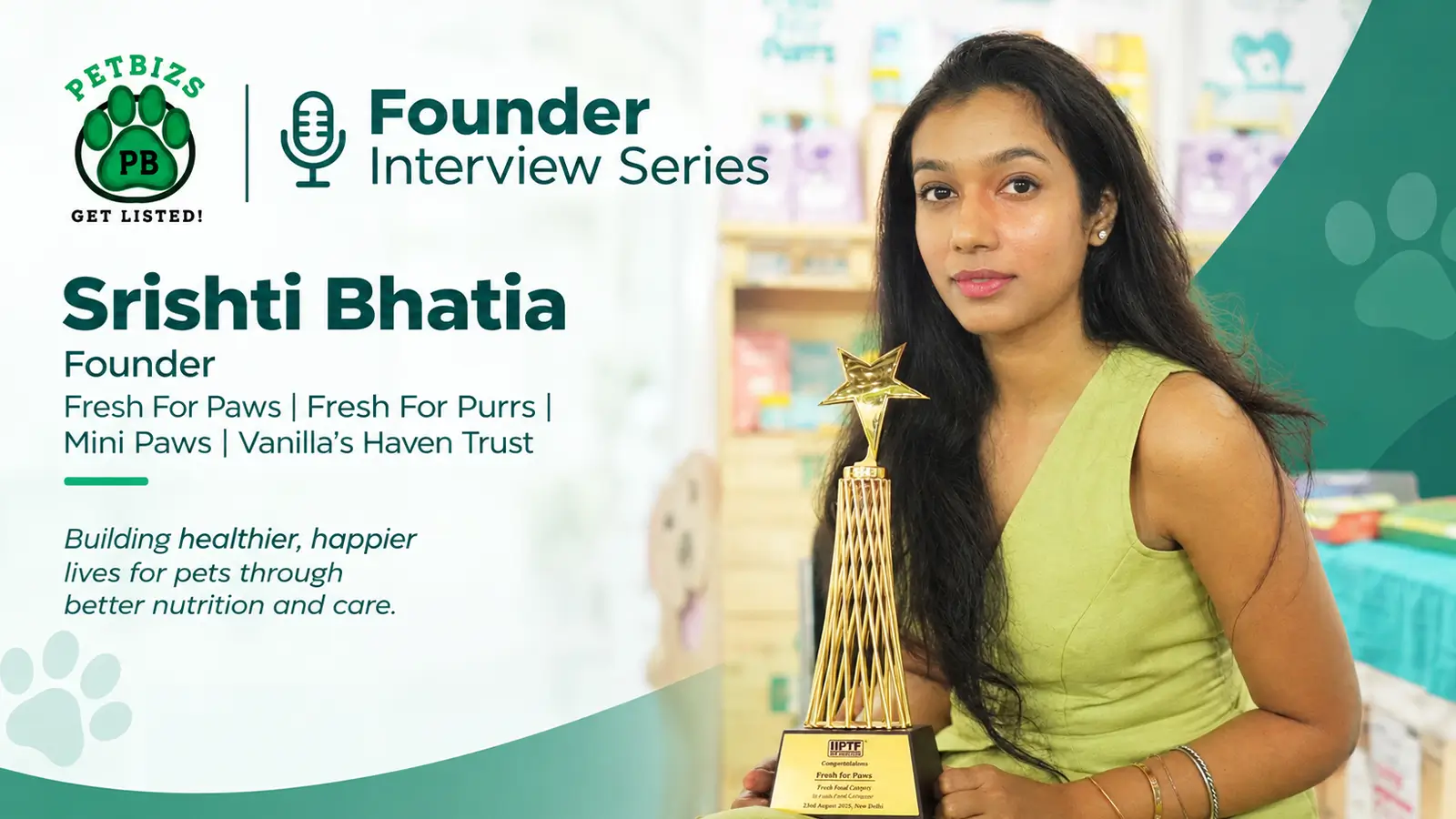
Srishti Bhatia built Ready-to-Eat Pet Food in her own kitchen, tested it on a Labrador named Vanilla, and created a category India never had
Every big idea starts with one small, personal decision. For Srishti Bhatia, that decision came in the form of a golden lab named Vanilla. She started asking a simple question: what am I actually feeding my dog? That question led her far from her commerce degree and into kitchens, labs, and years of trial and error. Eventually, it led her to build something India didn’t have yet: a real Ready-to-Eat Pet Food category.
In this PETBIZS interview, she opens up about that journey, the mistakes that shaped it, and the mission that still drives her today.
Srishti, thank you for opening up to PETBIZS about a brand that began with your own golden lab, Vanilla, as its very first taste tester. You went from a commerce graduate at Delhi University to a Certified Pet Nutritionist building your own food company. Can you walk us through what pushed you to make that leap into Fresh For Paws?
Fresh For Paws really started with Vanilla, not with a business plan.
When I got Vanilla, I became much more conscious of what I was feeding her. I started questioning what was actually going into pet food and whether there was a better way to feed our pets every day.
At that time, there wasn’t really a ready-to-eat pet food market in India. So I wasn’t simply entering an existing category; in many ways, we were creating the category itself.
I was a commerce graduate, had no family business background and wasn’t from a food-science background. But I was curious and willing to learn. So, I started researching nutrition, ingredients, formulation, preparation and preservation, and that curiosity eventually became a much bigger mission.
I didn’t initially set out to build a company. I set out to make better food for my own dog. Fresh For Paws grew from that.
Over the years, I realized that Fresh For Paws had to be about much more than the product. It had to be about changing the way people think about feeding their pets. Education has therefore always been a very important part of what we do. Before asking a pet parent to buy our food, I want them to understand nutrition, ingredients, and why the choices they make matter.
For me, Fresh For Paws is part of a much larger pet food revolution in India.
It took you nearly two years of research and testing before Fresh For Paws officially launched in June of 2018. What was actually happening during those two years that most people would never see from the outside?
Those two years were probably the most important part of building Fresh For Paws.
There wasn’t an established ready-to-eat market in India that I could simply look at and follow. There was no clear playbook. I had to learn, experiment, and figure out what would work.
I spent those two years researching nutrition, ingredients, formulation, preparation, preservation, packaging and shelf life. Every recipe was developed ingredient by ingredient, tested and refined. Vanilla was always part of that journey because she was the first pet I was trying to feed better.
There were recipes that didn’t work, processes that had to be changed and so many things I had to learn from scratch.
Those two years weren’t just about developing a product. They were about figuring out how to introduce an entirely new way of feeding pets to a market that wasn’t familiar with it.
I also knew that if we wanted ready-to-eat pet food to become a real category, we couldn’t simply put a product in front of people and expect them to understand it. We had to educate pet parents first.
Ready-to-eat pet food is still a fairly new concept for a lot of pet parents in India. How would you explain what that term actually means to someone who has only ever fed their dog kibble or home-cooked meals?
I would explain it very simply: ready-to-eat means the meal is prepared, portioned, and ready to serve.
A pet parent shouldn’t have to cook it, measure multiple ingredients, calculate portions, or plan their day around defrosting food. The idea is to make feeding a complete, thoughtfully formulated meal as simple as opening a pack and serving it.
For me, convenience isn’t about compromising on nutrition. It is about making better nutrition easier to follow consistently.
And because the concept was so new when we started, a big part of our job was not just selling the product but helping pet parents understand why ready-to-eat food could be a different way of feeding their pets.
Vanilla became what you call the venture’s taster in chief. How much influence did her actual preferences have over which recipes made it into the final Fresh For Paws lineup?
A lot. Vanilla was my first customer.
She had her own preferences, and I paid very close attention to what she liked, what she didn’t and how she responded to different recipes. But I also learnt very early that palatability alone isn’t enough to make good pet food.
So Vanilla helped me understand what pets enjoy eating, while the formulation process had to make sure the food was nutritionally appropriate as well.
She was the reason I started this journey, and she remained a very important part of it throughout the development of Fresh For Paws.
You portion every meal according to your veterinarian nutritionist’s calorie recommendations before it ever reaches a customer’s door. How does that level of precision change what ready-to-eat pet food actually means compared to a bag of treats a pet parent might scoop out themselves?
Portioning changes the way you think about a meal.
With ready-to-eat food, the intention is that the pet parent isn’t left guessing how much to serve. The meal is designed around the pet’s nutritional and calorie requirements rather than simply being something that looks healthy or tastes good.
That distinction is important to me. Feeding is something we do every single day, so I wanted to remove as much guesswork as possible while still making the experience simple for the pet parent.
You are a Certified Pet Nutritionist yourself, on top of running the business. How often do you personally recalculate or revisit a recipe once it is already out in the market?
I don’t believe a recipe should become untouchable just because it has already launched.
Over the years, I have continued to learn, review, and question what we are doing. Nutrition evolves, our understanding improves, and, importantly, our customers and their pets give us feedback that you can’t always get during development.
Any change, however, has to be purposeful. I don’t believe in changing a recipe simply for the sake of making it new. If we make a change, there needs to be a clear reason behind it, and the product still needs to meet the nutritional requirements we have set for it.
Fresh For Paws promises no scooping, no defrosting, and no guesswork. What convinced you that removing those small daily decisions was as important as the nutrition inside the ready-to-eat pet food itself?
Because I realized very early that good nutrition only works if people can actually follow it consistently.
Pet parents are busy. They love their pets, but feeding them every day also has to fit into real life. If something is nutritionally excellent but complicated to prepare, measure, or store, it becomes harder to maintain as a routine.
I wanted Fresh For Paws to remove those little barriers. The idea was always: make the right thing easier to do.
You expanded from Fresh For Paws into Fresh For Purrs for cats and Mini Paws for puppies, all built on the same ready-to-eat pet food model. What had to be true about your original dog-focused recipes before you felt confident building out those other lines?
The first thing that had to be right was the foundation.
I wanted to understand the ready-to-eat model thoroughly and make sure we had a strong understanding of formulation, nutrition, preparation, portioning, and preservation before expanding.
Cats and puppies aren’t simply smaller or different versions of adult dogs. Their nutritional needs are different, so each extension had to be approached on its own terms.
The model could remain consistent — making feeding simpler and more convenient — but the nutrition behind each product had to respect the pet it was designed for.
A lot of fresh food brands lean heavily on refrigeration or freezing to preserve quality. How does your ready-to-eat pet food stay fresh and nutritionally intact without asking customers to plan around a freezer?
This was actually one of the biggest technical challenges we had to solve when we were developing Fresh For Paws.
We use a retort process, which is a controlled heat-treatment and sterilization process that allows the food to remain shelf-stable without refrigeration or freezing until it is opened. The food is sealed in its packaging and goes through a carefully controlled retort process designed to ensure food safety and stability.
The process is important because we wanted to create the convenience of a ready-to-eat meal while maintaining the quality and nutritional integrity of the food.
That was always the objective — to give pet parents a meal they could keep conveniently at home and serve without having to plan their day around a freezer.
You avoid synthetic vitamins and minerals entirely, relying only on what comes from the ingredients themselves. Why did you decide that distinction mattered enough to build the entire brand around it?
I wanted to curate something that I would be completely confident feeding Vanilla myself, without having any second thoughts about what was going into her bowl.
That was always my benchmark. If I wouldn’t feel comfortable feeding it to her every day, I didn’t want to put it in someone else’s pet’s bowl either.
I wanted to understand every ingredient and have a clear reason for why it was there. I wanted the food to be made from ingredients I could recognize and trust.
And I always felt that if I could look at the ingredients and understand them myself — even as a human — that gave me another level of confidence in what I was creating for pets. Of course, pet nutrition has its own specific requirements, but that transparency was very important to me.
For me, it comes back to one simple question: would I confidently feed this to Vanilla every day? If the answer wasn’t an absolute yes, it didn’t belong in Fresh For Paws.
Testimonials on your site mention dogs refusing to eat their regular food once they have had a taste of yours. What do you think ready-to-eat pet food actually offers a dog’s palate that a bag of dry kibble simply cannot replicate?
Ready-to-eat food offers a very different eating experience.
Pets respond to aroma, texture and moisture, and a food that has the characteristics of a prepared meal is naturally very different from dry kibble.
But I don’t think the conversation needs to be about saying one format is automatically good and another is bad. For me, it is about giving pet parents another option — one that combines nutrition, palatability and convenience.
Vanilla definitely taught me that pets know what they like!
You run Vanilla’s Haven Trust alongside Fresh For Paws, feeding stray dogs and cats in your community. What made you decide that giving back needed to be built directly into the business rather than kept separate from it?
Vanilla started Fresh For Paws, so I always felt that I wanted to have something that carried her name forward as well.
Vanilla’s Haven Trust was created with that thought. I wanted to build something in her name that could continue to help pets who needed care, food, and support, even beyond our own pets.
There are so many dogs and cats who don’t have someone thinking about what is in their next meal or whether they are being cared for. So being able to give back in Vanilla’s name felt very personal to me.
For me, Fresh For Paws and Vanilla’s Haven Trust come from the same place. One started with my desire to give Vanilla a better life, and the other allows that love to reach more pets who need it.
Vanilla gave me the beginning of Fresh For Paws, and I wanted her name to continue being a part of something that gives back.
For a pet parent who has never tried ready-to-eat pet food before, what should they actually expect the first time they tear open a pack and serve it to their dog?
The first thing they’ll probably notice is the difference in the eating experience.
They should expect something that looks and smells much more like food than what they may traditionally associate with pet food. More importantly, they should expect simplicity — open, serve, and feed.
I also tell pet parents not to judge nutrition only by how exciting a product looks. What matters is what has gone into the meal, how it has been formulated, and whether it is appropriate for their pet.
You created every recipe yourself, devising and calculating each one ingredient by ingredient. What does that research process actually look like when you are trying to turn an idea into a finished, nutritionally complete recipe?
It starts with understanding the pet and the nutritional requirements rather than starting with a list of ingredients I simply like.
I look at the nutritional requirements, determine what the recipe needs to deliver, select the ingredients accordingly, calculate the formulation, and then test and refine it.
There is a lot of detail involved because every ingredient contributes something different. You have to think about the nutritional profile, palatability, digestibility, preparation, and how everything works together.
The creative part of recipe development is important, but the science has to be the foundation.
You offer both one-time purchases and monthly subscription plans for your ready-to-eat pet food. How do you think about designing a subscription model around something as personal as what a family feeds their dog every single day?
The biggest thing is flexibility.
Food is personal, and every pet is different. A subscription should make someone’s life easier, not make them feel locked into something.
At the same time, pet food is a recurring need. If we can make sure the right food reaches the pet consistently without the parent having to remember to reorder, every time that creates real convenience.
The subscription model is ultimately about turning good feeding into a sustainable everyday routine.
You are actively looking for retailers and distributors to expand your ready-to-eat pet food beyond direct delivery. What has been the hardest part of convincing a retail partner to carry a fresh food product instead of shelf-stable kibble?
The biggest challenge is changing an established way of thinking.
We had to explain what ready-to-eat pet food was, why it was different, how it was preserved, how it should be fed, and, most importantly, why pet parents would want it.
That’s why education has always been central to Fresh For Paws. We don’t want to simply sell a product; we want to create an informed consumer who understands why nutrition matters.
In that sense, Fresh For Paws has always been bigger than the product itself. We have been part of creating a new category and helping drive a pet food revolution in India.
You describe every pack of your ready-to-eat pet food as free of fillers and completely grain free. How do you balance that level of simplicity with still making sure each meal is nutritionally complete on its own?
Simplicity doesn’t mean nutritional compromise.
The goal isn’t to put as few ingredients as possible into a pack just so the ingredient list looks short. The goal is to use the right ingredients in the right formulation.
Every ingredient needs to have a purpose. The recipe then has to be evaluated as a whole to ensure that the meal provides what the pet needs.
That’s where the nutrition work behind Fresh For Paws becomes important. A simple ingredient list can still require a lot of science behind it.
You started this business as a commerce graduate with no formal food science background at the outset. What is the biggest technical gap you had to close yourself before you trusted your own recipes enough to sell them?
Understanding nutrition deeply enough to take responsibility for what I was putting into another person’s pet’s bowl.
In the beginning, I had curiosity but not expertise. So I had to learn. I became a Certified Pet Nutritionist and spent years understanding formulation, ingredients, nutritional requirements, and the technical side of producing a food product.
That learning never really stopped.
I think one of the biggest lessons of entrepreneurship is that you don’t need to know everything when you start. But you do need to be willing to admit what you don’t know and work relentlessly to learn it.
As more Indian pet parents move away from traditional dry food, how do you see ready-to-eat pet food positioned against both kibble on one side and fully raw diets on the other?
I see ready-to-eat pet food as another important option for pet parents — one that brings together nutrition, convenience, and a more food-like feeding experience.
When we started Fresh For Paws, the Indian market wasn’t really talking about ready-to-eat pet food. We had to create awareness around the category before we could expect people to understand the product.
And that’s something I feel strongly about even today: you cannot build a category only by selling a product. You build it by educating people.
That’s why our focus has always been on helping pet parents understand nutrition, ingredients, feeding, and the choices available to them. Once people become more informed, they naturally start asking better questions about what goes into their pets’ bowls.
I don’t think the future is about eliminating one format. It is about giving pet parents better choices and helping them make informed decisions about what works for their pets.
Your Instagram content leans playful and personality driven, featuring dogs, cats, and even Vanilla herself, all in service of making ready-to-eat pet food feel approachable. How intentional is that tone in building trust around a product this new to most pet parents?
It is very intentional, but it also comes naturally to us.
Pet food shouldn’t feel intimidating. At the end of the day, we are talking about pets, and there is so much joy and personality in that world.
I wanted Fresh For Paws to educate without becoming overly clinical or difficult to understand. We can talk about nutrition and still have fun. We can talk about responsible feeding and still show pets being pets.
And Vanilla has always been part of that personality because she is where this entire story began.
If a retailer or distributor is considering carrying ready-to-eat pet food for the first time, what would you want them to understand about how it actually performs on a shelf compared to what they are used to stocking?
I would want them to look at it as a category opportunity rather than simply comparing it with the shelf space occupied by conventional pet food.
Consumer behavior is changing. Pet parents are becoming more conscious about ingredients, nutrition and the overall quality of what they feed their pets.
Ready-to-eat pet food also has the potential to create a much more engaging conversation with the customer because it is still relatively new and different.
The category is evolving, and retailers who understand that shift can become part of that growth.
You have been running Fresh For Paws for several years now. What feedback from customers has actually changed a recipe or a process, rather than simply confirming you were already doing something right?
After eight years of building Fresh For Paws, customer feedback has become one of the most valuable parts of the business.
One thing we learnt quite early was that even when a product is technically right, the way it fits into a pet parent’s everyday routine can still be improved.
For example, we received feedback from customers about wanting greater clarity around portions and feeding instructions, especially because many of them were transitioning from kibble or home-cooked food and weren’t sure how to make the switch. That pushed us to make our feeding guidance and communication much clearer.
We’ve also had customers tell us about the individual preferences of their pets — what they enjoyed, what they didn’t, and how they responded when transitioning to the food. That kind of feedback has helped us look at palatability, portions, and the overall feeding experience more closely.
After eight years, I think one of the biggest lessons is that product development doesn’t stop when you launch. Your customers and their pets become part of that process. They use your product every day, so they notice things that you may not see from inside the business.
Where do you see ready-to-eat pet food heading over the next several years in India specifically, as more brands enter this space alongside you?
But for me, the opportunity is much bigger than simply growing one product category. When we started, there wasn’t a ready-made market for what we were doing. We had to create awareness, educate pet parents, and introduce them to a completely different way of thinking about everyday pet food.
That’s what I mean when I talk about a pet food revolution. It isn’t just about replacing one product with another. It is about changing the conversation around pet nutrition altogether.
At Fresh For Paws, we want to be part of that change — not just by making food, but by helping pet parents become more informed about what they feed their pets.
And ultimately, I want that revolution to go beyond India. I want us to build something here that makes India proud and puts Indian pet food on the global map.
If another founder wanted to build their own fresh pet food brand from scratch the way you did, what is the one piece of advice from your own two years of development you would want them to hear first?
Don’t rush the product.
The market may make you feel that you need to launch quickly, but if you’re feeding a pet, you have a responsibility beyond simply getting a product onto a shelf.
Take the time to learn. Understand the nutrition. Understand the ingredients. Test. Question your assumptions. Get things wrong during development so that you can get them right before launch.
I spent nearly two years before launching Fresh For Paws, and today I know those two years were not lost time. They were the foundation.
As we wrap up, what do you want pet parents across India to understand about the future of ready-to-eat pet food, and the kind of everyday meal you believe every dog and cat deserves?
Fresh For Paws has never been only about making another pet-food product.
It started with one dog, Vanilla, and a very simple question: Can I feed her better?
But over the last eight years, that question has grown into something much bigger. We’ve helped create a new category in India, educate pet parents, and change how people think about everyday pet nutrition.
For me, that is the real pet food revolution — not just what we put into the bowl, but how much more consciously we think about what belongs there.
I want pet parents to ask better questions, understand what they are feeding, and have access to better choices for their pets.
My ambition is to take that even further — to build an Indian pet food brand that can stand on a global stage and make India proud.
Ultimately, I want every pet to have access to food that is thoughtfully made, nutritionally considered, and convenient enough to become part of everyday life.
Srishti’s story proves that you don’t need a food-science degree to change an entire industry. You just need curiosity, patience, and a reason to care. She turned two years of quiet research into a brand that now serves thousands of pets across India, and she isn’t done yet.
Her next goal reaches far beyond one country: she wants Indian pet food to earn a place on the world stage. So the next time you open a pack of Ready-to-Eat Pet Food, remember that it started with one dog, one question, and one founder who refused to settle for less.
Read Srishti’s full interview, then share it with a pet parent who’s ready to rethink what’s in the bowl.